

Opinion · Fundamental Rights · Access to Justice
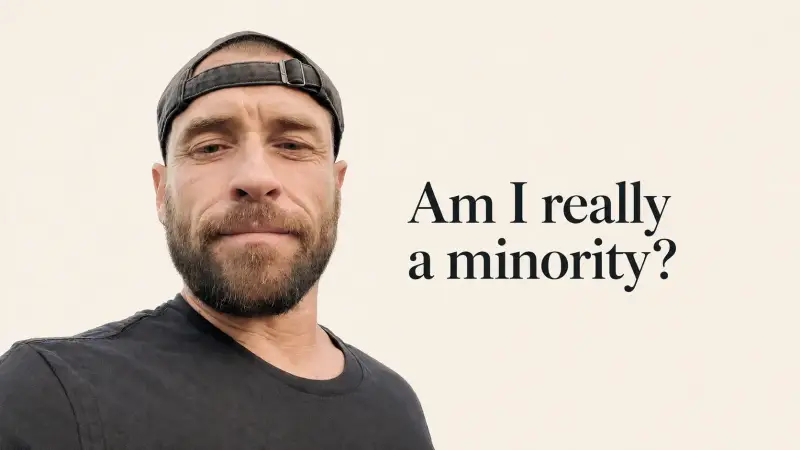
One in five people lives with a disability. One in six is racialized. One in five will, at some point in their life, carry the weight of an addiction. One in twenty-five belongs to the 2SLGBTQ+ community. The list goes on. Add up the « minorities », and you discover that the majority the legal system speaks to may not exist.
The word « minority » does work. It names, it protects — and it isolates. It carves up the population into groups treated separately, as though they had nothing in common. But when you do the math honestly, the margins, added together, vastly exceed the centre. And meanwhile, access to justice continues to be indexed to that centre — a centre that no longer exists.
I — The word that isolates
« Minority » isn’t a number. It’s a function.
Section 10 of the Charter of Human Rights and Freedoms of Quebec lists fourteen prohibited grounds of discrimination : race, colour, sex, gender identity or expression, pregnancy, sexual orientation, civil status, age, religion, political convictions, language, ethnic or national origin, social condition, handicap. Taken one by one, these grounds define « minorities ». Taken together, they cover most of the population.
And yet the word does constant rhetorical work. It suggests that the people it designates are the exception, the special case, the adjustment to be made at the margin of a system designed for someone else. It is precisely this presupposition — that the system is normal and the minority must adapt — that demographic reality contradicts. The « default » litigant — the one for whom the system is, in practice, still designed — is someone who can pay their lawyer, who reads their file in their first language, who understands legal vocabulary because they went through school, and who walks into the courtroom without physical or sensory barriers. This profile is broadly documented by access-to-justice research12 and by several Quebec public inquiry reports3. Everyone else — the immense rest — faces, at every step of the process, obstacles that this model-litigant doesn’t have to face : having to explain themselves, prove their good faith, negotiate their own presence, or be denied accommodations that should be self-evident. We have documented the refusal of reasonable accommodations in Quebec courthouses — a file we will return to.
II — Do the math
The arithmetic of the margins
The figures that follow come from Statistics Canada, the Institut de la statistique du Québec, the Canadian Centre on Substance Use and Addiction, and the Quebec Ministry of Health and Social Services.
People living with a disability : 27 % of Canadians aged 15 and over, or 8 million people (CSD 2022). In Quebec, 21 %. The most marked increase concerns mental health.
Racialized people : 16.1 % of Quebec’s population in 2021 (1.3 million people), 26.5 % in Canada, with a projected 38 to 43 % by 2041.
Immigrants : 14.6 % in Quebec, 23 % in Canada in 2021.
2SLGBTQ+ community : more than 1.3 million Canadians aged 15 and over (~4.4 %). Police-reported hate crimes based on sexual orientation rose 69 % between 2022 and 2023.
People with alcohol or drug dependencies : these are ill people who need help, not moral failings to be punished. 21.6 % of Canadian adults (about 6 million) meet, at some point in their life, the criteria for a substance use disorder. Alcohol alone affects 18.1 % for abuse or dependence. Quebec has the highest alcohol consumption rate in the country.
People experiencing homelessness : approximately 10,000 people in visible homelessness in Quebec in 2022, +44 % since 2018. Sheltered homelessness rose another 15 % in 2024. Hidden homelessness is not counted.
Seniors : nearly 20 % of Quebec’s population. Among those 65 and over, the disability rate reaches 40 %.
Neurodivergent people : roughly one in five according to broad estimates (autism, ADHD, dyslexia, tic disorders).
To this add people without a diploma, people living below the low-income cut-off, women who are victims of intimate partner violence, single-parent families, and Indigenous people.
The margins of Quebec and Canada, in numbers
Percentage of the population affected by each category, displayed on a 0–30 % scale for readability. Overlaps (a single person may belong to several groups) are not counted.
Add them up. Account for overlaps, without overestimating them : an autistic person can also be racialized, an immigrant, poor, and have experienced homelessness. What appears isn’t a mosaic of minorities. It’s the population.
« Minority » no longer describes a demographic reality. The word describes a power relationship.
— EnDroit.caIII — The case that struck me
When a letter becomes a diagnosis
I am the founder and editor of EnDroit.ca, formerly Justice-Quebec.ca. I am also an autistic person, with Tourette syndrome and ADHD. I am also someone who has fought, all my life, against alcoholism and drug addiction — and who feels no shame about saying it, because the shame belongs to the system that turns illness into moral failure, not to those who are the first wounded by it. I am also a dad. I am also a human being.
In recent weeks, our newsroom has been looking into a file that was brought to its attention. A lawyer practising in Quebec sent to a person living with the same neurodevelopmental conditions as I do — autism and Tourette syndrome — a three-page demand letter in which she accumulated, against this person, deeply discriminatory psychologizing characterizations. These characterizations were directly contradicted, point by point, by the person’s formal neuropsychological report — a report signed by a member of the Order of Psychologists of Quebec, which the lawyer had in her possession at the time she wrote her letter.
The author of the letter went so far as to use medical and psychiatric terms she has no professional qualification to assign, in order to publicly discredit an autistic person. All of it placed under the cover of protecting the children of a client — an invocation which, on examination, serves less the cause of the children than a set of personal, professional and institutional positions that we will document in detail. Seized of the disciplinary complaint, the Quebec Bar’s syndic dismissed the file out of hand ; seized next on the basis of discrimination, the CDPDJ did exactly the same. This case will be the subject, in the coming weeks, of a full investigative report in collaboration with a partner.
IV — Who does justice belong to?
The case isn’t isolated — and no one corrects it.
If I speak here of that file, it isn’t to detail it — we’ll do that elsewhere. It’s because it isn’t isolated. At EnDroit.ca we receive dozens of testimonies every week from people who have been refused a reasonable accommodation, refused the right to be accompanied, refused the right to a lawyer, refused the right to be heard, refused access to their own court file.
When you line these testimonies up side by side, one question imposes itself : who does justice belong to ? And who has the responsibility to correct its dysfunctions ? The Quebec Bar (Barreau du Québec) ? The Ministry of Justice ? The Quebec Ombudsperson (Protecteur du citoyen) ? The Human Rights and Youth Rights Commission (CDPDJ) ? The Director of Criminal and Penal Prosecutions (DPCP) ? The courts ? The Office of the Professions (Office des professions du Québec) ? The table below offers a transversal reading, institution by institution, grounded in their public mandates, in the Professional Code, and in the EnDroit.ca reports listed beneath it.
Seven institutions, seven structural limits
A cross-cutting reading of the seven institutions that should correct access-to-justice dysfunctions, based on the Professional Code, the public mandates of the bodies in question, and EnDroit.ca’s own investigations cited below.
| Institution | Stated mandate | Structural limit |
|---|---|---|
| Barreau du Québec (Quebec Bar) | Protect the public | Its Professional Liability Insurance Fund (FARPBQ) insures the lawyer in question and funds the defence ; its Office of the Syndic receives the complaint, investigates it, and decides what action to take. The professional order is therefore at once insurer and investigator in files against its own members. |
| Ministry of Justice of Quebec | Oversee the administration of justice | Headed by a minister who is also Attorney General, supported by an apparatus in which jurists who are members of the Quebec Bar are numerous. The self-regulation of professional orders is enshrined in the Professional Code (1973) — a regime which the Ministry has the trusteeship to apply. |
| Quebec Ombudsperson (Protecteur du citoyen) | Watch over the quality of public services | Recommendatory powers only. Even accepted recommendations are not always implemented. The institution does not intervene directly in individual cases. |
| CDPDJ (Human Rights and Youth Rights Commission) | Defend human rights and the rights of youth | Frequently declines jurisdiction in discrimination files connected to the justice system ; refers the litigant back to the Bar or the courts — the very institutions being called into question. In the discrimination file referred to in the previous section, the complaint was closed in precisely that manner. |
| DPCP (Director of Criminal and Penal Prosecutions) | Authorize and conduct criminal and penal prosecutions | Does not itself conduct investigations : it decides whether or not to authorize charges based on files transmitted by police forces. Composed of prosecutors who are members of the Bar, it does not, in practice, bring charges against the Bar, against lawyers, or against police officers — a pattern documented repeatedly in our investigations. |
| Courts and judiciary | Decide disputes | Judges are recruited from among lawyers who are members of the Bar with at least ten years of practice. The principle of judicial independence requires them to rule within the bounds of the files before them and the applicable law ; systemic reform of the oversight institutions is not, in practice, something they undertake on their own initiative. |
| Office of the Professions of Quebec | Supervise the professional orders | Long-documented inaction in the face of the breaches observed. According to our investigations, the « watchdog » has been muzzled. |
The conclusion is harsh, but it is documentary : there is currently no institution in Quebec whose mandate, structure and independence allow for a real and systemic correction of the dysfunctions of access to justice. Every oversight mechanism in place refers, at one point or another, back to the Bar — or to another body that refers back to yet another. The institutions pass the ball among themselves, never stepping in, in a staggering complexity — and yet what’s at stake is people in situations of vulnerability, who should, on the contrary, benefit from the greatest simplicity.
V — Taking back what was taken
If we are the numbers, we are the legitimacy.
The idea isn’t to collapse every struggle into a single one. A senior is not a racialized person, is not an autistic person, is not a person experiencing homelessness. Each has their own issues, their own vocabulary, their own demands.
But these groups share a common experience : that of having rights written on paper that are not fully applied to them in practice. That of having to prove, at every institutional encounter, that they deserve what should be theirs by default. That of being treated as the exception that, statistically, they are not.
Access to justice — real access, not theoretical access — is not a gift to beg for. It is a right to demand. And it is demanded more effectively when many people demand it together.
Conclusion
In 2026, we have the numbers. And the tools.
In 2026, we have the numbers. We have the data. We have the digital tools to share our testimonies, compare our files, document what the institutions would rather we didn’t document. And now, we have visibility. EnDroit.ca, with its relaunch in the coming days, will come back bigger, broader, with more collaborators, a strengthened team, better investigations, better resources — so that the documentation of these dysfunctions doesn’t remain the task of a few isolated voices.
It is time to stop thinking of ourselves as « minorities ». It is time to gather. And it is time to demand three things that should never have ceased to exist : real equality of access to justice, transparency from the institutions tasked with protecting it — the Quebec Bar, the Office of the Professions, the Ministry of Justice — and effective accountability from those who exercise these powers in our name.
The question is no longer how to protect minorities. The question is : when will we, who together are the majority, take back what already belongs to us ?
Autistic, alcoholic, drug-dependent, neurodivergent, racialized, immigrant, experiencing homelessness, single parent, senior. Placed end to end, these people are not the minority. They are the majority no one names.
EnDroit.ca · Together we go further
Editorial note. This article is an opinion piece grounded in public data from Statistics Canada, the Institut de la statistique du Québec, the Canadian Centre on Substance Use and Addiction, and the Quebec Ministry of Health and Social Services.
Illustrative case. The case referred to in Section III is presented in anonymized form. It will be the subject of a separate investigative report, in collaboration with a partner, to be published on EnDroit.ca.
Notice. EnDroit.ca does not provide legal advice. The author is not a lawyer. For any personal question, consult a member of the Quebec Bar or contact the Commission des droits de la personne et des droits de la jeunesse (CDPDJ) : 1 800 361-6477.
1.Pierre Noreau, Chloé Leclerc, Moktar Lamari and Maya Cachecho, Indice québécois d’accès à la justice : Concept, mesure et analyse (Quebec Access-to-Justice Index : Concept, Measurement and Analysis), research report submitted to the Quebec Ministry of Justice, ADAJ-Chantier 25, June 30, 2022, 41 pages plus appendices. View the report.
2.Action Committee on Access to Justice in Civil and Family Matters, Access to Civil and Family Justice : A Roadmap for Change, chaired by the Honourable Thomas A. Cromwell, Ottawa, Canadian Forum on Civil Justice, October 2013. View the Cromwell report (PDF).
3.Public Inquiry Commission on Relations between Indigenous Peoples and Certain Public Services in Quebec : Listening, Reconciliation and Progress (Viens Commission), Final Report, chaired by the Honourable Jacques Viens, September 30, 2019, 520 pages. The Commission documented systemic discrimination in Quebec public services, notably in justice services. View the Viens Commission website.
Disability. Statistics Canada, Canadian Survey on Disability, 2017 to 2022, The Daily, December 1, 2023 : 27 % of Canadians 15+. Institut de la statistique du Québec, Statistiques sur les personnes handicapées, CSD 2022 : 21 % in Quebec.
Racialized people. Statistique Québec, Personnes issues de minorités visibles, 2021 Census : 16.1 % in Quebec (1,341,000 people). CIRANO, Les minorités visibles nées au Canada, 2023 : 26.5 % in Canada, projection 38–43 % by 2041.
2SLGBTQ+. Statistics Canada, Socio-economic profile of the 2SLGBTQ+ population aged 15 and over, 2019 to 2021, The Daily, January 25, 2024 : 1.3 million people (~4.4 %). Hate crimes based on sexual orientation : +69 % in 2023 according to police data.
Substance use disorders. Canadian Centre on Substance Use and Addiction (CCSA), Canadian Drug Summary : Alcohol : 21.6 % of Canadian adults (~6 million) meet, at some point in their life, the criteria for a substance use disorder ; 18.1 % for alcohol. Quebec, 84.2 % past-year prevalence — the highest in the country.
Homelessness. Quebec Ministry of Health and Social Services, Dénombrement des personnes en situation d’itinérance visible au Québec — Rapport de l’exercice du 11 octobre 2022, September 2023 : ~10,000 people (+44 % compared to 2018). Sheltered homelessness enumeration report of April 23, 2024 : 9,307 sheltered people, +15 % compared to 2022.
Charter. Charter of Human Rights and Freedoms of Quebec, CQLR, c. C-12, s. 10.
This article is an opinion piece. EnDroit.ca is an independent legal-journalism platform. The author is not a lawyer. No part of this article constitutes legal advice.
Ajouter un commentaire
Commentaires