

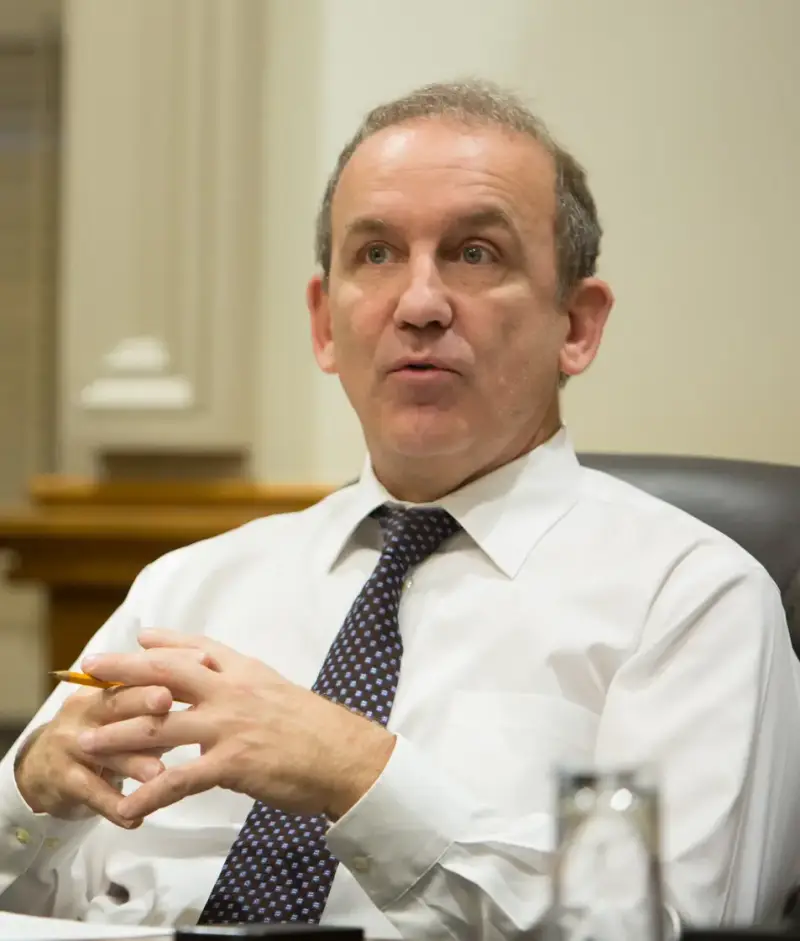
In December 2017, the National Assembly rose, member by member, to publicly reprimand one of its own — 105 votes in favour, zero against. What no one knew then: the key witness behind the report that led to that condemnation would, six years later, plead guilty to criminal charges of fraud, forgery and perjury.
How It Unravelled: 2016–2017
In 2014, Claude Surprenant was elected MNA for Groulx under the Coalition Avenir Québec banner by a margin of fewer than 300 votes. Three years later, his former political attaché, Julie Nadeau — whom he had dismissed on December 7, 2016, on the recommendation of the National Assembly's human resources department, after a forensic accounting report he had commissioned revealed irregular transactions totalling $9,483.19 in the constituency office bank account — went to the media with accusations against him.
Nadeau alleged that he had used his staff for partisan purposes and mismanaged his office finances. Her partner at the time, Yann Gobeil-Nadon — himself a former political attaché in Surprenant's office — added his voice to hers. Their statements landed like a bombshell in a charged political context: the CAQ was in opposition, eighteen months from a general election, and was banking on ethics issues to unseat the Couillard government.
On January 17, 2017, Carole Poirier, House Leader of the official opposition, formally requested that the Ethics Commissioner investigate Surprenant. Nine days later, Stéphane Billette, House Leader of the Liberal government, did the same. The request was part of a broader series of investigations into eight other MNAs on similar grounds — the use of public funds for partisan purposes.
On January 24, 2017, before the commissioner's report had even been tabled, the CAQ expelled Surprenant from its caucus. He now sat alone as an independent in a chamber where every party had an interest in projecting ethical rigour.
The 2017 Report: What the Commissioner Found — and What It Was Based On
On November 30, 2017, ad hoc commissioner Jacques Saint-Laurent tabled a report of more than sixty pages (file DE-02-2017). Headlines spoke of an MNA censured for ethical failures. The reality of the report was more nuanced — and that nuance was largely ignored.
On Nadeau's central allegations concerning partisan use of staff, the commissioner was explicit: the evidence contained no factual elements suggesting that the partisan dimension had risen to the level of a breach of the Code. In plain terms: Nadeau's core accusations against Surprenant were not upheld.
Three genuine breaches were nonetheless found — and naming them clearly is necessary to understand what makes this case so revealing:
1. Yann Gobeil-Nadon — Nadeau's partner — simultaneously held the presidency of the CAQ's youth commission while being paid by the National Assembly, work the commissioner deemed substantially partisan.
2. Paulo Gervais was receiving two National Assembly salaries for the same period — one from Surprenant, one from the whip's office — without any corresponding reduction in his constituency pay.
3. Surprenant had awarded a $715 contract to his architect partner for the renovation of his office — something Article 16 of the Code prohibits without exception, regardless of the amount.
These three breaches are real — ad hoc commissioner Bélanger upholds them in her 2024 report. Surprenant was not entirely without fault. But these infractions bear no resemblance to the allegations of embezzlement and "ghost employees" that had driven the headlines.
What changes everything is the question of sanction. The commissioner recommended a public reprimand — rather than a simple note on file — because Surprenant had, in his view, attempted to mislead him about the office's financial management. It is in paragraphs 260 to 280 of the report that Julie Nadeau's testimony becomes central: she denied having embezzled funds and placed the blame on the MNA. The commissioner believed her.
The eight other MNAs under similar investigations received no reprimand. Surprenant was the only one sitting as an independent — with no party to protect him, no voice to defend him. Amir Khadir, then MNA for Mercier, said it plainly: sanctions that only fall on the most vulnerable are no longer justice.
On December 6, 2017, the National Assembly adopted the report by 105 votes in favour, zero against, five abstentions. CAQ members voted against their former colleague. It was the first time in Quebec parliamentary history that an elected official had been publicly reprimanded by peers assembled in the chamber.
What the Commissioner Did Not Know: The Full Picture of the Key Witness
The revelations about Julie Nadeau accumulated over five years, each more serious than the last.
February 2022 — Administrative Labour Tribunal (2022 QCTAT 862): After eleven days of hearings, the TAT ruled unequivocally that Nadeau had diverted funds from the constituency office bank account into her personal account, had negligently managed the office's financial resources, and had lied to the MNA during the investigation that preceded her dismissal.
The decision also noted that Nadeau had submitted a forged university degree during the hearings. Having first claimed to hold a law degree from Université Laval, then a nearly completed master's degree, she was forced to admit — when confronted with a letter from the university confirming no such credential had ever been issued — that the document was a forgery. This same lie had been told before the Ethics Commissioner in 2017.
December 2022 — UPAC Criminal Charges: The investigation established that between August 2014 and December 2015, Nadeau had diverted more than $8,000 from the office account, submitted falsified medical documents to extend a leave of absence, and committed perjury on four separate occasions before the TAT between 2018 and 2021.
Julie Nadeau pleaded guilty to all three charges brought by the UPAC: fraud, use of forged documents, and perjury (R. v. Nadeau, files 700-01-188964-228 and 700-01-188965-225).
She was sentenced to 15 months of imprisonment served in the community, three years of probation, and a fine of $2,400 — including $100 per month repaid to Claude Surprenant. A token amount, symbolic at best, against an incalculable moral debt.
The 2024 Bélanger Report: A Surgical Conclusion
On December 7, 2023 — exactly six years after the reprimand was adopted — the National Assembly passed a motion tabled by House Leader Simon Jolin-Barrette, mandating the Ethics Commissioner to determine whether new facts warranted reopening the 2017 investigation. Commissioner Ariane Mignolet appointed an ad hoc commissioner on December 20, 2023.
On May 8, 2024, Me Dominique Bélanger, a former judge of the Quebec Court of Appeal, tabled her report. Its conclusion is both precise and devastating to the internal logic of the original report.
She upholds the three breaches found in 2017: they rest on documentary evidence that stands independently of Nadeau's credibility. But on the question of sanction, her analysis is unambiguous:
"It is clear that had the Commissioner at the time known that Julie Nadeau had lied to him about holding a law degree, that she had forged documents and that she had diverted funds from the bank account, he would have questioned her testimony regarding the financial management of the office."— Me Dominique Bélanger, ad hoc commissioner · Report of May 8, 2024
"Without Julie Nadeau's deception, one can reasonably conclude that the Commissioner at the time would not have found Claude Surprenant to have acted in bad faith. The Commissioner at the time would not have recommended that a sanction be imposed on MNA Surprenant had the new facts been known at the time."— Me Dominique Bélanger, ad hoc commissioner · Report of May 8, 2024
In plain terms: there were real breaches, but there should never have been a public reprimand. That rare symbolic act — 105 parliamentarians rising one by one to condemn a colleague — rested in part on the testimony of a person later convicted of perjury.
Me Bélanger recommends that the reprimand be annulled and that paragraphs 260 to 280 and 286 to 302 of the original report be "deemed unwritten." She adds, in her closing remarks, that the Ethics Code contains no provision allowing for the review of a commissioner's report in light of new facts — and recommends that the National Assembly address this gap. That recommendation has yet to be implemented.
On May 30, 2024, the National Assembly voted to annul the reprimand. Unanimously.
What the Bélanger Report Establishes — At a Glance
| Element | Status After 2024 | Reason |
|---|---|---|
| Breach — Gobeil-Nadon (partisan work) | Upheld | Documented independently of Nadeau's testimony |
| Breach — Gervais (double salary) | Upheld | Documented independently of Nadeau's testimony |
| Breach — Contract to partner ($715) | Upheld | Documented independently of Nadeau's testimony |
| Finding of bad faith (par. 260–280) | Deemed Unwritten | Based on testimony of a person later convicted of perjury |
| Public reprimand | Annulled | Would never have been imposed had the new facts been known |
What Remains: Institutional Silence and a Lawsuit
The annulment of the reprimand should have marked the beginning of a reparation process. Three elements remain unresolved — and their accumulation says something about the nature of the problem.
The 2017 report is still online. The National Assembly annulled the reprimand, but did not remove the document from the Ethics Commissioner's website. The man is officially cleared, yet the text that condemns him — bearing the words "subterfuge" and "bad faith" — remains accessible to anyone who searches his name.
No financial compensation has been granted. According to what the former MNA has publicly recounted, the government House Leader had encouraged him to fight to the end. Former chief whip Mario Laframboise had confirmed he would personally handle the follow-up. Figures had been discussed. A partial settlement was reportedly accepted by Surprenant in December 2024 — and never materialized. In November 2024, he formally claimed more than two million dollars from the National Assembly. The Speaker indicated a wish to remain "neutral."
In May 2025, he filed suit. Receiving no concrete response, Claude Surprenant launched an action for more than three million dollars against the Attorney General of Quebec and the CAQ — noting the irony that the party had rushed to condemn its former member in 2017 to signal its commitment to transparency, yet drags its feet when it comes to repairing the injustice it helped create. Contacted by Justice-Quebec.ca, the Coalition Avenir Québec indicated, through its Director of Communications, that it is the National Assembly and not the party that is at issue in this matter, and declined to comment on the lawsuit as the case is before the courts.
The human cost deserves to be named. In the 2018 election, without the CAQ banner and carrying the stigma of the 2017 report, Surprenant lost his own riding. The stress destroyed his marriage. His relationship with his children suffered. He withdrew from public life for seven years to avoid damaging the reputation of employers still willing to work with him.
What This Case Reveals About Our Institutions
The Surprenant affair exposes a structural flaw that commissioner Bélanger herself documents: the Ethics Code contained no mechanism to review a commissioner's report in light of new facts. It took a political motion, an ad hoc commissioner appointed six years after the fact, and a criminal guilty plea for the process to be set in motion. Without Surprenant's relentless effort to document and pursue his case, nothing would have happened.
Multiple independent bodies reached the same conclusion — the Administrative Labour Tribunal, UPAC, the Court of Quebec, and a former Court of Appeal judge appointed as ad hoc commissioner. The injustice is established. It has not been repaired.
"The National Assembly voted to reprimand him in minutes. Two years after voting to exonerate him, it has still taken no steps to make him whole."
— Justice-Quebec.caThe question this case raises — one that no one in the institutions involved has yet answered — is this: what message does it send to those considering a career in public life when they see that a false accusation can destroy a career, and that the institution that condemned them then refuses to accept its share of responsibility?
In his opinion piece published today in the Journal de Montréal, Claude Surprenant addresses the new Premier Christine Fréchette — who has said she wants to put her capacity to act in the service of people. He asks her a simple question.
"Courage is not something you claim. It is something you demonstrate. There is still time."
- Justice · Ethics The Judges Who Shame Quebec
- Conflict of Interest The FARPBQ: An Institutionalized Conflict of Interest Since 2020
- Access to Justice Goldwater Speaks Out, the Syndic Shuts Down, the Judge Looks Away — Children Wait
Primary sources: Quebec Ethics and Professional Conduct Commissioner — Investigation Report concerning Claude Surprenant, November 30, 2017 (file DE-02-2017) · Report of ad hoc Commissioner Me Dominique Bélanger, May 8, 2024 · Administrative Labour Tribunal — Nadeau v. Surprenant, 2022 QCTAT 862 · UPAC — R. v. Nadeau, conviction of November 14, 2023 (files 700-01-188964-228 and 700-01-188965-225) · Quebec National Assembly — Journal of Debates, December 7, 2023 and May 30, 2024 · Court of Quebec, Small Claims Division — Surprenant v. Nadeau, March 9, 2018
Secondary sources: Radio-Canada, Le Devoir, La Presse, Journal Nord Info, Droit-inc, L'actualité — coverage 2017–2026 · Le Devoir — opinion piece by Alexandre Dumas, August 14, 2025 · Journal de Montréal — opinion piece by Claude Surprenant, April 15, 2026
This article is an editorial analysis based on verifiable public sources. Justice-Quebec.ca is an independent citizen platform. It does not constitute legal advice. The author is not a lawyer.
Ajouter un commentaire
Commentaires