

Justice · Police · Systemic Discrimination
The lack of diversity in Quebec's police forces is not a recruitment problem. It is a choice — and the communities that bear its consequences deserve to understand precisely how that choice is perpetuated.
← Part 1
Discrimination in Plain Sight — the Legal Architecture of Exclusion from Quebec's Police Profession
I — The Diagnosis
What Derrick Bell Would Have Recognized
The late Professor Derrick Bell, of Harvard Law School and one of the founding fathers of critical race theory, argued that racism in North America does not survive solely through hatred. It is perpetuated through institutional policies: the quiet, cumulative effect of rules that appear neutral on their face but systematically produce the same outcomes for the same communities. Quebec's police institutions are a near-perfect illustration of this thesis. This article traces the problem back to its source: personal information collected from racialized people during police street checks, kept without their knowledge, then used years later to close doors those people didn't know existed.
The statistical data attest to the first part of this finding. After years of diversification plans, the SPVM (Montreal Police Service) increased the proportion of visible-minority officers from 4.94% to 8.05% between 2005 and 2019.1 Three percentage points. Fourteen years. According to the most recent data compiled by Statistics Canada, visible minorities — internally categorized as belonging to a racialized group — currently represent only about 1% of all officers in the Sûreté du Québec (SQ), Quebec's provincial police.2 That is one officer in fourteen, in a province where visible minorities make up roughly one seventh of the population.
Three percentage points. Fourteen years.
— Alain Babineau, JD/BCLBell would have recognized this phenomenon immediately. He described it under the concept of racial realism: the idea that racial progress tends to be more visible in institutional discourse than in the outcomes actually produced. Plans are drafted. Offices are opened. The gap, however, remains. What keeps that gap in place are obstacles — and in Quebec policing, these obstacles are not accidental. They form a structural system.
As I noted in Part I of this series, the Canadian citizenship requirement for police employment has been unconstitutional since the Supreme Court of Canada's 1989 ruling in Andrews3 — yet it persisted in Quebec for years. The swimming test, required by certain services, cannot lawfully be justified as a bona fide occupational requirement under the standard set by the Supreme Court in 1999 in Meiorin4 — yet it has remained in force. The academic threshold used in certain recruitment processes disadvantages candidates from communities whose schools have themselves been found systematically underfunded and discriminatory by the province's own human rights commission. Bill 21 prohibits anyone wearing a religious symbol from holding most positions of state authority, de facto excluding practising Muslims, Sikhs, Jews and members of other religious communities from any police career.
Each of these barriers has been identified, studied and recommended for removal by Quebec's own Advisory Committee on Police Reality.5 Each time, the recommendation was noted — and the barrier remained. Bell called this phenomenon interest convergence: barriers to racial progress tend to survive when their removal would impose a cost on the institutions that benefit from them.
II — The Invisible Barrier
Security Screening: The Barrier You Never See Coming
But the most damaging barrier is the one you never see coming. It appears in no job posting. Candidates only face it at the very end of the process, after months of tests, interviews and preparation: the security and integrity screening.
Research conducted both in Canada and the United States has consistently shown that background checks constitute one of the main points of elimination for racialized candidates in police recruitment processes6 — not because of criminal records, but because of how those checks are designed and what they treat as disqualifying.7 To understand what is at stake, it is important to grasp what those checks actually rely on.
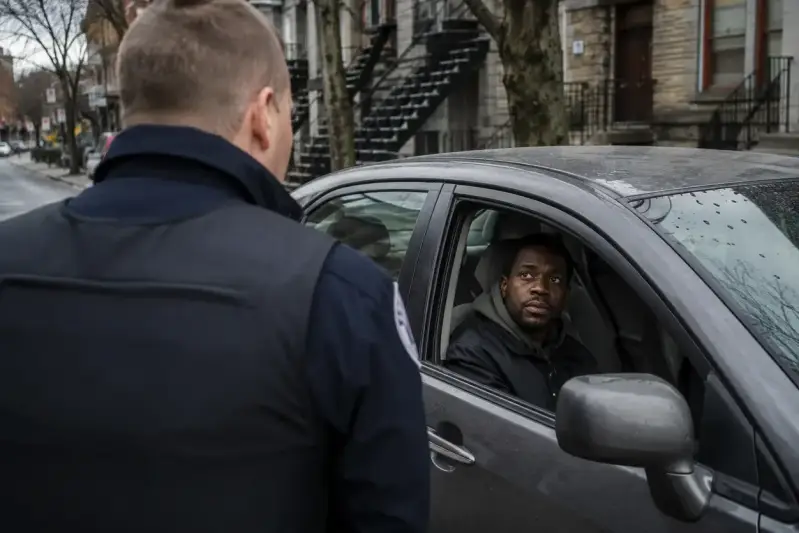
In Quebec — as in most of Canada — police officers have long had the practice of stopping people in public spaces, asking for their identification and recording their personal information: name, address, physical description, identity of those accompanying them. These practices are known as street checks (interpellations). They require no suspicion of a criminal offence. No charges are laid. No arrest is made. The person stopped is free to leave (according to police leadership) — but their data is entered into a police database. And it remains there in perpetuity.
Legal researcher Christina Abbott (University of Saskatchewan, 2017)8 found that police services across Canada retain these records indefinitely — longer than they are authorized to retain actual criminal conviction records — and that these records are used to screen employment applications. Canadian courts have further established that street checks engage the protections of the Canadian Charter of Rights and Freedoms, even without physical detention.
In R v Grant,9 the Supreme Court held that a person's rights are engaged the moment police clearly convey (verbally or physically) that the person is not free to leave. The street check records in the SPVM database were built through a process that the courts have recognized as constitutionally sensitive. Security screening draws on those records without ever informing the candidate of their existence, without giving them any opportunity to challenge them, and without the consent-based protections the courts require.
III — The Street Checks
The Community That Bears the Weight of Collection
The community that bears the weight of this data collection is no mystery.
Criminologist Mathieu Charest, mandated by the SPVM itself following the death of Freddy Villanueva in 2008, concluded that between 30 and 40% of young Black men in Montréal-Nord and Saint-Michel had been stopped and subjected to identity checks by police — compared with five or six percent of their white peers in the same neighbourhoods.10 When anti-gang operations intensified between 2001 and 2007, street checks targeting Black residents increased by 126% in Montréal-Nord and 91% in Saint-Michel. The SPVM rejected his findings. At the same time, the organization was maintaining a database of 10,000 names considered to be linked to street gangs, while its own estimates put the actual number of active gang members in the city at around 500. Those 10,000 names are not a record of criminal acts. They are a record of being Black in certain Montreal neighbourhoods, reformatted as a risk profile.
The Charest Figures — Montréal-Nord and Saint-Michel
Between 30 and 40% of young Black men in Montréal-Nord and Saint-Michel were stopped and subjected to identity checks by police — compared with five or six percent of their white peers in the same neighbourhoods.
Between 2001 and 2007, street checks targeting Black residents increased by 126% in Montréal-Nord and 91% in Saint-Michel.
SPVM database: 10,000 names considered to be linked to street gangs; SPVM's own internal estimate of the actual number of active gang members: about 500.
Researcher Benoît Décary-Secours of CREMIS has traced the genesis of this phenomenon: a wave of press articles in the late 1980s introduced the idea of a gang crisis tied to Haitian and Jamaican immigrant communities — before such gangs were even actually present in the city.11 Fear came first. The surveillance infrastructure built to manage that fear came second. It is that infrastructure that today feeds the security screening process.
Those 10,000 names are not a record of criminal acts. They are a record of being Black in certain Montreal neighbourhoods, reformatted as a risk profile.
— Alain Babineau, JD/BCLIV — Two Closed Doors
What This Means for a Career
Here is what this concretely means for a person trying to build a career. A young Black man was stopped by police about a dozen times — between 10 and 12 times — without valid grounds, in the 18 months after obtaining his driver's licence. He committed no wrongdoing. His name is added to the system. Five years later, he applies to the SPVM. He has a diploma, professional experience and no criminal record. He passes the written tests, the physical tests and the psychological evaluation. He reaches the security interview. The investigator questions him about the street checks. This man, who has learned over time to be cautious in the presence of police, doesn't mention them, or downplays them. That caution — perfectly reasonable in light of his lived experience — is recorded as a lack of honesty. He is rejected. Not for any act he committed. But because of how data, illegally collected and indefinitely retained, was handled in a process that warned him of nothing and provides no recourse. This is precisely what could have happened to Joseph-Christopher Luamba (the Luamba case12) had he aspired to become a police officer.
Miriam Ikhlef Is Not a Hypothesis
Miriam Ikhlef13 is not a hypothesis. A graduate of the Université de Montréal in police and security studies, she worked as a 911 dispatcher for the SPVM for thirteen months. She received a commendation for her handling of a call involving a barricaded man in suicidal crisis. In June 2021, after passing nearly every stage of the SPVM recruitment process, she was told she had failed the security screening. No explanation was given. The only justification she could identify: a 2003 deportation order against an uncle she had never met, on terrorism-related grounds — an uncle who was later acquitted by an Algerian court. During her security interview, she was asked whether she attended a mosque and why she had chosen to study at Collège de Maisonneuve. Miriam Ikhlef has no criminal record and no link to any criminal activity. Her case is not an isolated exception. It illustrates how security screening was designed to work: digging into a candidate's family history, religious practice and community ties — with no obligation to explain, and no possibility of contesting.
V — The Price of the System
What a Denied Career Costs
The economic cost of all these mechanisms is real, precise and considerable. A first-year SPVM constable earns a base salary of $112,082. With overtime, total annual compensation regularly exceeds $125,000, plus a defined-benefit pension plan — guaranteeing a fixed monthly income for life after retirement — and the full protection of a collective agreement.14 An average security guard in Quebec earns roughly $41,000 to $46,000 per year.15 No pension plan. Minimal benefits. No job security. Quebec has more private security guards per capita than any other Canadian province.16 Visible-minority workers have more than doubled their share of that workforce since 1996, far exceeding their representation in the general population.17
The Compensation Gap Between Two Security Careers
First-year SPVM constable: base salary of $112,082, total annual compensation regularly exceeding $125,000 with overtime, defined-benefit pension plan and collective agreement.
Average security guard in Quebec: between $41,000 and $46,000 per year. No pension plan. No job security.
Over 25 years of service: an SPVM officer will have received, conservatively, between $2.5 and $3 million in total compensation, pension included. A security guard, less than half that amount, with no wealth accumulated at the end.
The communities pushed out of police forces are therefore the same ones filling the ranks of private security — doing security work for a fraction of the pay, without any of the related protections. An officer retiring from the SPVM after 25 years of service will have received, conservatively, between $2.5 and $3 million in total compensation, pension included. A security guard working the same number of years will earn less than half that amount, with no wealth accumulated at the end.
That gap translates concretely into a mortgage you cannot obtain, a retirement that does not exist, university studies a parent cannot afford to offer their child. It is the direct, material result of a street check on a Montreal corner, of a name entered into a database, and of a security screening that closed a door the candidate never saw. It is Quebec law that built this system. It built it so that one specific community would bear its weight.
It is Quebec law that built this system. It built it so that one specific community would bear its weight.
— Alain Babineau, JD/BCLVI — The Permanence of Denial
What Must Change
In 2023, the SPVM commissioned a major study on racism within its ranks. The Armony report revealed that 85% of SPVM officers believe there is no significant racism problem within their organization. This, despite two judicial decisions finding systemic discrimination. Despite the Charest data. Despite everything. Bell also described this phenomenon under the concept of the permanence of racism — not to claim that nothing ever changes, but to mean that institutions under pressure tend to absorb criticism, produce a new discourse, and continue operating as before. The information is available. The judicial decisions exist. The disparity is documented. And the people charged with making the necessary changes mostly do not believe the problem exists.
Dr. Bell did not advise giving up. He advised being lucid about what is actually needed. What is needed here is concrete: an end to discretionary street checks, as the researchers themselves recommend in the Armony report; the disaggregation of diversity data by specific community — not a catch-all "diverse" category, but disaggregated data for Black, Arab, Latin American and Indigenous people, at every stage of the process, from application to promotion; a legal limit on how long street check records can be retained, together with the right of affected individuals to consult and contest the information about them; and a real seat at the decision-making table for CRARR, the Red Coalition and the lawyers currently before the courts on these street checks — not as symbolic gestures, but as effective oversight mechanisms.
I have been having these conversations for twenty years. Twenty years ago, I was recruiting officers for the RCMP because Quebec police services refused to take them. Today, I am having the same conversations with a new generation of qualified, committed people who want to serve their communities and continue to hit the same walls.
The document that carries the name of a young man from a corner of RDP, Montréal-Nord, NDG or Bordeaux-Cartierville to a rejection letter a decade later is not a neutral administrative record. It is a political decision. It takes money from families. It denies people careers they earned. It does all of that quietly, under cover of procedures and processes. Bell's most important lesson is this: we do not fight these systems because we are certain of winning. We fight because the witness of the fight is itself a form of justice — and because the people who bear the cost of this system deserve, at the very least, a system honest enough to recognize what it does.
We fight because the witness of the fight is itself a form of justice — and because the people who bear the cost of this system deserve, at the very least, a system honest enough to recognize what it does.
— Alain Babineau, JD/BCLComing next — Part 3
The Third Part of the Series
This article is the second in a three-part series signed by Alain Babineau for the Red Coalition. The third part will follow.
Original document
Author's original letter — available for download
This article is also available in its original version, as written and signed by Alain Babineau.
Information as leverage. Access to justice for all.
Justice-Quebec.ca · Together, we go further
Editorial note. This article reproduces in full the thought and analysis of Alain Babineau, JD/BCL, from an original text signed by the author for the Red Coalition. Justice-Quebec.ca is an independent citizen platform of legal journalism.
The opinions expressed in this article are those of the author. They do not constitute legal advice. For any personal matter, consult a member of the Barreau du Québec.
- Jonathan Montpetit, "Montreal Police Trying to Attract More Diverse Recruits, but Barriers Remain" (May 7, 2021), online: CBC News cbc.ca.
- Sarah Leavitt, "Quebec's Police Forces Still Overwhelmingly White" (March 24, 2016), online: CBC News cbc.ca.
- Andrews v. Law Society of British Columbia, [1989] 1 SCR 143.
- British Columbia (Public Service Employee Relations Commission) v. BCGSEU (Meiorin), [1999] 3 SCR 3.
- Advisory Committee on Police Reality, Final Report: Modernity, Trust, Efficiency (Québec: Government of Québec, May 2021) at p. 123, online (pdf): Ministère de la Sécurité publique cdn-contenu.quebec.ca (in French).
- Andrew Welsh-Huggins, "Tests, Background Checks Can Thwart Police Diversity Effort" (October 2, 2020), online: CityNews Ottawa ottawa.citynews.ca.
- Anne Li Kringen and Jonathan Allen Kringen, "Identifying Barriers to Black Applicants in Police Employment Screening" (March 2015) 9:1 Policing: A Journal of Policy and Practice 15, doi.org/10.1093/police/pau034.
- Christina Marion Abbott, Street Checks and Canadian Youth: A Critical Legal Analysis (master's thesis in law, University of Saskatchewan, College of Law, 2017), online (pdf): University of Saskatchewan HARVEST Repository harvest.usask.ca.
- R v Grant, 2009 SCC 32, [2009] 2 SCR 353.
- Katia Gagnon, "Profilage racial : les rapports internes du SPVM déposés en preuve" (September 30, 2010), online: La Presse lapresse.ca (in French).
- Benoît Décary-Secours, "« Gangs de rue » et brouillage médiatique : les jeux d'ombre d'un nouveau racisme" (2019) 11:2 Revue du CREMIS 11, online: CREMIS cremis.ca (in French).
- Jonathan Montpetit, "Supreme Court to Hear Quebec Appeal of Ruling Against Random Traffic Stops", online: CBC News cbc.ca.
- Jacob Serebrin, "Aspiring Montreal Police Officer Believes Career Blocked Because of Uncle She Never Knew" (March 10, 2023), online: Global News globalnews.ca.
- Service de police de la Ville de Montréal, "Benefits", online: SPVM Recruitment recrutementspvm.ca.
- Charco Security, "What Is the Salary of a Security Guard in Quebec in 2026?" (March 10, 2026), online: Charco Security charco.ca.
- Geoffrey Li, Private Security and Public Policing, cat. no. 85-002-X, vol. 28, no. 10, Juristat (Ottawa: Statistics Canada, December 2008), online (pdf): Statistics Canada statcan.gc.ca.
- Andrea Taylor-Butts, Private Security and Public Policing in Canada, 2001, cat. no. 85-002-XIE, vol. 24, no. 7 (Ottawa: Statistics Canada, 2004), online (pdf): Statistics Canada publications.gc.ca.
This article is a signed analysis by Alain Babineau, published by Justice-Quebec.ca, an independent citizen platform. It does not constitute legal advice.
Ajouter un commentaire
Commentaires