

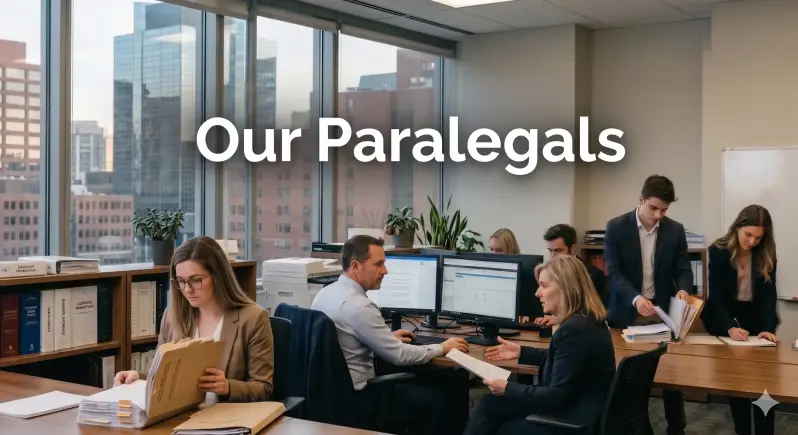
At the bottom of every court filing, only one name is printed: the lawyer's. Yet behind that name, there is a person — and often several — who held the file together, calculated the deadlines, drafted the successive versions, and saved the lawyer from oversight. That person carries a title the public has not yet learned to respect: paralegal. Seven thousand of them keep Quebec's justice system running, day after day. And most Quebecers still don't know they exist.
Seven thousand people no one sees
According to the most recent data from Emploi-Québec, more than 7,000 paralegals, legal technicians, legal researchers, and legal assistants were working in Quebec in 2022. Nearly 88% of them are women. Almost 89% hold full-time positions. They work in law firms and notaries' offices, in the legal departments of large corporations, in federal, provincial, and municipal public services, in courthouses, in bailiffs' offices, in insurance companies, and in financial institutions.
Sources: Emploi-Québec (2022); Chambre des notaires du Québec; IMT en ligne; Robert Half, Demand for Skilled Talent (2025).
Seven thousand people. That is nearly twice the number of active notaries in Quebec, which hovers around 3,800 to 4,000 according to public data from the Chambre des notaires. It represents a decisive share of the province's legal workforce. And yet, ask an ordinary citizen what a paralegal does: the answer will most often be a shrug. Something administrative. A support function. Someone who "helps lawyers." This vagueness is not innocent. It reflects a symbolic hierarchy that no longer corresponds to the reality of the work being done on the ground.
A demanding technical training — systematically underestimated
Quebec's college diploma in paralegal studies (program 310.C0) is a three-year, full-time program — roughly equivalent to a Bac+2 in the French system, or two years of college plus an additional intensive year of professional training. It is offered in about twenty public and private CEGEPs across Quebec — from Collège Ahuntsic, which has been training legal technicians for more than fifty years, to Cégep de la Gaspésie et des Îles, which now offers the program entirely online to reach remote regions.
The content is anything but light. Civil Procedure I and II, criminal law, administrative law, labour law, commercial and corporate law, title examination, publicity of rights and securities, legal drafting I and II, advanced legal research, professional ethics. Students learn to use CanLII, SOQUIJ, the Land Register, the RDPRM, and the Quebec Enterprise Register. They draft procedures, contracts, and acts. They analyze judgments, prepare evidence, and follow files from start to finish in simulations that closely mirror real practice. The program includes two internships, one of which is full-time during the final session.
Legal research — interpret laws, regulations, case law, and doctrine. Find the precedent that changes a file's outcome.
Drafting procedures — originating applications, defenses, motions, formal demands, sworn declarations, conclusions.
Evidence preparation — chronologies, exhibit binders, examinations, hearing documents.
Deadline tracking — prescription, service, filing, readiness for trial. A missed deadline can destroy a file or a career.
Title examination and publicity of rights — the foundation of every real estate transaction.
Full file management — from opening to closing, in matters as varied as family, corporate, real estate, banking, criminal, and labour law.
By the end of their training, graduates enjoy one of the highest placement rates of any technical program in Quebec, according to data from the Pygma system and the provincial Relance survey. The market wants them. Firms are waiting for them. The shortage is well documented: according to reports from Robert Half and specialized recruiters, Quebec is experiencing a persistent shortage of legal technicians in 2025-2026, particularly in business law, commercial law, real estate law, and banking law. For legal assistants, the number of positions grew by 13% between 2019 and 2024, or about 800 new positions per year. The legal system can no longer function without them. And yet, it still has not learned how to name them properly.
A confusion of titles — and the haze it creates
Several titles coexist, and their entanglement contributes to the invisibility of the profession. To understand the role of paralegals in Quebec, one must first untangle the threads.
| Title | Typical training | Primary role |
|---|---|---|
| Legal technician | College diploma in paralegal studies (3 years) | Research, drafting, file management, procedural follow-up |
| Paralegal | College diploma or university certificate in law | Often specialized: corporate, real estate, litigation, intellectual property |
| Legal researcher | College diploma, sometimes a law degree | In-depth legal research, case law analysis |
| Legal assistant | Vocational diploma in secretarial studies + specialized 450-hour legal certificate | Administrative management and file coordination |
| Bailiff | College diploma in paralegal studies + specialized training | Service of documents, enforcement of judgments, formal reports |
One particularity deserves mention. In Quebec, since 1989, only two categories of people may aspire to the profession of bailiff: holders of a law degree, and holders of the college diploma in paralegal studies. The 1995 Bailiffs Act subsequently established the Chambre des huissiers de justice du Québec as a self-regulating professional order with exclusive practice rights. The college diploma in paralegal studies is, in this respect, a credential expressly recognized by the legislator as sufficient to access a fully-fledged judicial profession. It is a detail few citizens know — and one that says a great deal about the seriousness of the training.
The real work — the kind no signature reveals
To understand what paralegals truly accomplish, one must move beyond job descriptions — which say nothing about the profession — and watch a firm in the heat of action. A major case, a tight deadline, six brilliant lawyers drafting a brief in parallel. Multiple versions, scattered arguments, crisscrossing emails, last-minute references to verify. The lawyers are thinking. Someone else is holding it all together.
"In the middle of this turmoil, it's the legal assistant or paralegal who organizes the team like a conductor. She redistributes tasks, reminds everyone of deadlines, merges versions, and turns a monumental mess into a coherent and powerful document."— Pierre-Olivier Lapointe, Groupe Lafortune, in Droit-inc, April 2026
This description is not exceptional. It captures the reality of most major files. The paralegal knows the rules of procedure better than many junior lawyers. She knows the tactical details of the case. She knows the commitments made at the previous hearing. Above all, she knows her lawyer — how he works, what stresses him out, what helps when the pressure rises. This accumulated knowledge appears in no job description, but it is what allows a firm to function.
To truly grasp what a paralegal does day to day, one must listen to those who live the profession from the inside. Maxime Gallagher-Trudel, a senior paralegal in a Quebec City firm, offers a comparison that says it all:
"Our profession does not consist solely of administrative tasks. It also means supporting our colleagues in analyzing and managing files, as well as drafting certain procedures. To draw a comparison, we are a bit like the dental hygienists of a law or notary office. We are not allowed to give legal advice directly to clients, but we are able to brief the professional handling the file — on the situation and on possible courses of action."— Maxime Gallagher-Trudel, senior paralegal in Quebec City
The image is apt, and it sheds light on a fundamental misunderstanding. In the medical sector, no one confuses a dental hygienist with a mere receptionist. Her training is recognized, her clinical role is regulated, and the patient knows precisely what she can do and what falls to the dentist. In Quebec's legal world, that clarity does not yet exist.
Daniel Kanga, a legal technician at the office of Me Yanick Péloquin, expresses the same reality from the perspective of a beginner who has just completed the program:
"What people often misunderstand about the work of a paralegal is just how much rigour, autonomy, and reflection it demands. From the outside, many imagine an administrative or technical support role, when in practice you must constantly stay organized, anticipate the needs of a file, understand procedures, and ensure every detail is handled with precision — because a single error can have real consequences."— Daniel Kanga, legal technician at the office of Me Yanick Péloquin
And there is the human dimension, the one rarely spoken of. It is often the legal assistant or paralegal who answers the phone when a client calls in tears. She is the one who reassures, who takes notes, who defuses. In Quebec, legal assistants are even formally trained for this: their role explicitly includes welcoming people in distress. For many citizens, she is the first human face of justice.
Deadlines — where the real power hides
In a legal file, the content matters, but the deadlines are decisive. An originating application not served within the prescribed time can result in the outright dismissal of the case. A missed limitation period can mean losing a right forever. A forgotten response can lead to a default judgment. For a lawyer, missing a deadline is not a minor lapse: it is a fault that can lead to a complaint to the Bar, a professional liability claim, and the loss of a client.
Yet these deadlines — extinctive prescription, service deadlines, readiness deadlines, filing deadlines, appeal deadlines — are, in most firms, tracked and flagged by paralegals and legal assistants. They are the ones who keep the calendars, the reminder systems, the dashboards. They are the ones who alert the lawyer when a deadline is approaching. They are the ones who make sure the filing happens on time. The lawyer's career depends, day after day, on their rigour.
Several recent studies place the average employee turnover rate at between 20% and 25% across Quebec workplaces. In law firms, this figure is regularly exceeded for administrative and paralegal staff. Industry surveys converge on the same finding: lack of professional development and weak recognition rank among the top reasons for leaving. The first years are decisive — that is when paralegals and legal assistants decide whether to stay in the profession or leave it for good.
When turnover is high, it is never an accident. It is the signal of an organization where invisible work has become exhausting, where recognition is missing, where processes are weighed down. And when these people leave, they take with them an accumulated knowledge of files, procedures, and clients that no training can quickly rebuild.
The client pays — without always knowing who is doing the work
There is another, more discreet form of invisibility, and it directly affects the citizen. When a person consults a law firm, they think they are interacting with a lawyer. They do not know — and often no one will tell them — that a large part of the technical work on their file will be done by a paralegal: research, drafting initial versions of procedures, tracking deadlines, preparing evidence. The client receives the bill at the lawyer's hourly rate. The paralegal is paid a fraction of that amount.
This is not a scandal in itself: a lawyer's supervision remains essential, and it is the lawyer who bears professional responsibility for the file. But the lack of transparency creates a gap between what the client thinks they are buying and what they actually receive. Some firms now adopt a clearer approach — naming the team, presenting roles, billing paralegal hours and lawyer hours at distinct rates. This practice respects two people at once: the client, who better understands what they are paying for, and the paralegal, whose contribution finally stops being invisible on the bill.
"When someone wants to buy a business, they tend to work closely with the lawyer on file — who designs the acquisition strategy. But the paralegal's work at this stage is crucial: it allows us to flag potential red flags. From my point of view, recognition by clients or the public is secondary, as long as recognition from our colleagues is there."— Maxime Gallagher-Trudel, senior paralegal in Quebec City
An interprovincial absurdity
There is a comparison within Canada that should make us think. Since May 1, 2007, Ontario has been the first jurisdiction in North America to recognize the paralegal profession as a fully-fledged regulated legal profession. Ontario paralegals obtain a licence from the Law Society of Ontario after accredited college training and an entrance exam. They can represent clients in Small Claims Court, in the Provincial Offences Court, before administrative tribunals, and — since 2019 — before the courts for certain summary criminal offences. They can give legal advice, negotiate, and bill their services directly to the public.
And Ontario continues to expand their scope. In December 2022, Convocation approved the creation of a new Family Legal Services Provider licence, which will allow trained paralegals to help clients fill out joint uncontested divorce applications and motions to vary child support — matters that, until then, had been reserved for lawyers. The publicly stated rationale for this opening is explicit: improving access to justice for citizens who cannot afford a lawyer.
In Quebec, the same person, with the same training — often longer and more rigorous than what is required in Ontario — has no direct access to the public. She can represent no one. She can give no legal advice. She can bill her services only through a lawyer. The profession is registered with none of Quebec's 46 recognized professional orders. It has no self-regulating body, no public code of ethics, no professional roll.
This difference is not neutral. In Quebec, access to justice is in crisis. Delays are long, costs are high, and many citizens appear in court alone because they cannot afford a lawyer. Meanwhile, an army of people trained to assist lower courts, draft procedures, and prepare files is forbidden from helping the public directly. Can Quebec, in 2026, afford to do without this resource? The question deserves, at the very least, to be raised publicly.
A person who has the skills to represent a client in Toronto finds herself, in Montreal, forced to work exclusively in the shadow of a lawyer. This is not a question of qualifications. It is a question of recognition — and of political will.— Justice-Quebec.ca analysis
An 88% female profession — and the unspoken effort
Nearly nine out of ten paralegals in Quebec are women. That figure alone speaks volumes about the profession's place in the symbolic hierarchy of the justice system. The most visible legal roles — the trial lawyer, the judge — remain associated with male figures, despite the rapid feminization of the Bar and the bench over the past thirty years. The so-called "support" roles, however, remain almost exclusively female. And almost exclusively invisible.
This invisibility carries a material cost. According to data from Éducaloi and the federal Job Bank, paralegal pay in Quebec spans a wide range: from $30,000 to $35,000 at entry for beginners, up to $90,000 or more for experienced legal technicians in large firms, and beyond $100,000 for senior paralegals leading teams in corporate or intellectual property law. But these peaks are rare, and progression is slower than in most other legal professions. Meanwhile, their workload, their level of de facto responsibility, and their knowledge of the law often grow faster than their recognition.
There is no scandal to denounce here. There is a cultural drift to correct. A collective habit of treating these women as accessories to a job they are, in fact, the daily engine of.
To students in paralegal studies — a word
Every year, hundreds of students walk through the doors of the CEGEPs of Saint-Jérôme, Garneau, Ahuntsic, Lanaudière, Sorel-Tracy, Valleyfield, the Outaouais, and Carleton-sur-Mer. They choose a rigorous, dense, technical program. They learn to read a legislative text, to navigate case law, to draft a procedure, to examine a real estate title. They will graduate with a placement rate few programs can claim.
To these students, one simple thing must be said: your training is not a service track. It is not "technical" in the diminishing sense the word has taken on. It is a path of expertise. You will be the only people in the firm who know the deadlines of the Code of Civil Procedure by heart. You will be the ones lawyers ask, quietly in their early years, how to prepare an exhibit binder or a service. You will be the link without which the file does not move forward.
But don't take our word for it. Listen instead to those who do the work.
"Don't underestimate the richness of this profession. It is demanding — it requires discipline and meticulousness — but it offers a concrete immersion in how the justice system works, and it is an excellent school for building a solid understanding of the legal world."— Daniel Kanga, legal technician at the office of Me Yanick Péloquin
"Come and try it for a day. You will see for yourself what we do day to day, how stimulating this profession is, how the hours pass in what feels like minutes, how we are surrounded by professionals who share their knowledge with us — and how, at the end of the day, you feel you have made a difference in someone's life."— Maxime Gallagher-Trudel, senior paralegal in Quebec City
Quebec's legal system does not run on its public figures. It runs on you.
"When someone says 'Counsel,' they look at the lawyer. When a file ends well — within deadlines, with the right exhibits and the right evidence — it's because someone else, in the shadows, did their work with a rigour no one ever bothered to acknowledge."
— Justice-Quebec.caWhat the shortage should teach us
Quebec's legal market is going through a level of activity it has never seen before. According to Robert Half's Demand for Skilled Talent report published in 2025, the unemployment rate among lawyers stands at 2.4%, well below the national average. Firms are scrambling for experienced legal technicians. The specialized site Droit-inc counted nearly 200 active legal job postings in Quebec by mid-August 2025.
"We have never seen a market this tight. Candidates literally have their pick, and they can afford to be very selective about working conditions, company culture, and even location."— Marina Gérard, legal recruiter at Uman Recrutement, in Droit-inc, August 2025
This shortage is not just an economic signal. It is a moral one. It says the profession has been kept too long in a grey zone where training was demanding, the actual work considerable, but recognition weak. The new generations coming out of the CEGEPs no longer accept being treated as if their expertise were a given, where overtime is expected but never celebrated, where their contribution is only noticed when it falters.
The firms that will retain their paralegals are the ones who will name them, advance them, pay them in line with their actual workload, and recognize them publicly in the files they help carry forward. The others will keep replacing staff every eighteen months — paying, without seeing it, the price of their blindness.
Seven thousand people stand up Quebec's judicial machinery, every single day. They calculate the deadlines no one celebrates. They draft the first versions others will sign. They answer the tearful clients lawyers do not have time to listen to. They close the files others have opened.
The paralegal is not the lawyer's assistant. The paralegal is the pillar without which justice would collapse — silently, in less than a week.
- Legal profession Notaries: Quebec's forgotten masters
- Legal profession Lawyer or notary in Quebec: who does what?
- Legal profession The legal profession: myth and reality of a burned-out career
- Data 29% of lawyers leave the profession within 5 years
- Association Canadian Association of Paralegals (CAP)
This article is editorial analysis based on publicly verifiable sources. Justice-Quebec.ca is an independent citizen platform. It does not constitute legal advice. The author is not a lawyer.
Acknowledgments: Justice-Quebec.ca warmly thanks Daniel Kanga (office of Me Yanick Péloquin) and Maxime Gallagher-Trudel (Quebec City firm) for sharing their perspectives on the profession in this article.
Ajouter un commentaire
Commentaires