

By Maxime Gagné — Justice-Quebec.ca · May 2, 2026
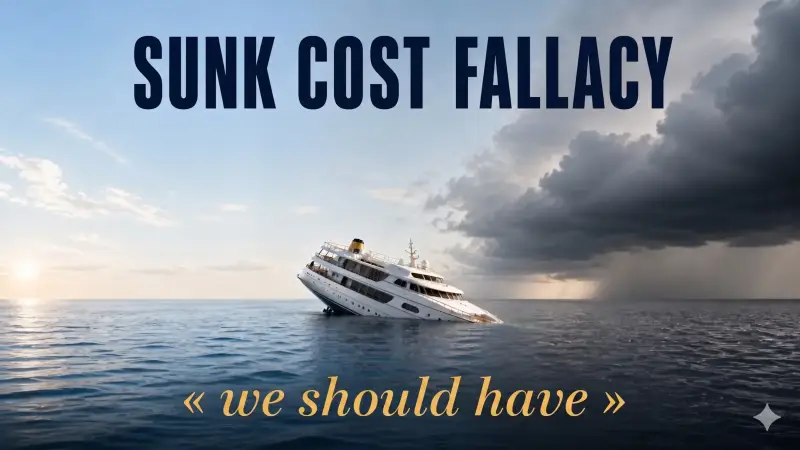
In behavioural economics, it is called the trap of irretrievable costs — the sunk cost fallacy. In plain English, it is the familiar “I have invested too much to walk away now.”
It is one of the best-documented psychological and legal mechanisms in the business world. And one of the most universally ignored by those who fall into it.
This article tells how it works — and why it almost always ends with the same phrase: we should have.
A mechanism that does not discriminate
The trap strikes everywhere, and always for the same reasons. It strikes the restaurateur, the retailer, a law firm, the insurer, the professional firm of every size and every sector. Anywhere a reputation can be threatened by a single fault, anywhere a leader can convince themselves that acknowledging the error would cost more than denying it, the same scenario plays out.
To illustrate it, we have chosen the example of a restaurant. Not because it is unique, but precisely because it is universal: the mechanism observed there reproduces itself, with minor variations, in any business caught in the same machinery.
And since this publication deals with law and institutional dynamics, the reader will draw the parallel themselves as the article unfolds.
Act one: the isolated fault
Imagine a Michelin-starred restaurant. An established institution, recommended in culinary magazines, cited as a benchmark in its segment. The owners have devoted years of work to it and built a reputation few establishments achieve.
One evening, a client falls seriously ill after a meal. The internal investigation reveals an isolated kitchen error — an improperly stored product, a momentary lapse, a single incident in an operation that handles thousands per year.
The client returns a few days later. They do not ask for much: a symbolic compensation, the acknowledgement that something went wrong, a gesture.
The restaurant refuses.
It is here, at this precise moment, that everything tips. Not later, not in the months that follow. There, in the refusal of a simple, human-scale repair.
Article 1457 of the Civil Code of Québec sets out the principle of civil liability: anyone who causes injury to another through their fault is bound to make reparation for it.
The fault may be minor, the harm modest, but the duty to repair exists as soon as three elements are met: fault, damage, causal link. Reparation offered quickly and in good faith extinguishes the dispute in the vast majority of cases.
So why, then, does the restaurant refuse?
Act two: the machinery sets itself in motion
The initial refusal almost always rests on the same assessment: the client is judged to be a nuisance, their case inconsequential, their persistence presumed to be limited. It is a calculation of pride, not of law. And it ignores one fundamental thing: you never know who you are dealing with.
The dissatisfied client posts a review. Then another. They contact a journalist. They file a lawsuit. Along the way, they discover that they have more resources, more patience, or a wider network than the restaurant had assumed.
The restaurant’s insurer then enters the scene. And it is here that the mechanism grows complex in ways that few owners anticipate.
The insurer owes a duty of loyalty to the insured. It is a central principle of insurance law, codified at articles 2400 and following of the Civil Code. The insurer must defend its client in good faith, negotiate honestly, and not expose the insured to unreasonable risk in order to serve its own interests.
However, the insurer also has interests of its own: limiting payouts, protecting ratios, avoiding precedent. When those interests come into tension with those of the insured, that is where bad faith can take hold, sometimes without anyone naming it as such.
In our example, the insurer makes the same decision as its client: defend rather than settle. It backs the narrative of the troublesome plaintiff. It refuses to negotiate. It digs in.
It is worth pausing here on a crucial detail. At the outset, the owners of the restaurant were not the source of the fault. The negligence came from a kitchen employee, on a given evening, in circumstances they had not directly controlled. They could legitimately have publicly acknowledged the error, compensated the client, dismissed the responsible party, and moved on. But by choosing to protect the establishment rather than to take responsibility for the incident, they shifted the very nature of their liability. The initial fault belonged to someone else. The cover-up, however, became theirs. This shift, almost imperceptible at the moment it happens, is one of the most universal mechanisms of the sunk cost fallacy: one enters the trap trying to protect someone else, and emerges from it months later realizing that one has become the target oneself.
Behind the insurer looms the reinsurer — the insurer’s insurer. When this party becomes aware of the file, they discover that the initial risk assessment was likely misrepresented to them. They now have an interest of their own in the facade holding, because its collapse would expose their own negligence.
And above all of this, the health inspector who had passed through the month before the incident also discovers the file belatedly. Their report at the time judged the sanitary conditions to be compliant. To reveal now the full extent of the problem would mean putting their own diligence into question, and above them, that of the supervising ministry. The administration chooses prudent silence. It lets the file run its course without intervening, hoping it will fade on its own. This same mechanism reproduces itself identically in other sectors when a professional order, an oversight body, or a regulatory authority belatedly discovers that a file it should have caught has slipped through.
At the top, several powerful actors each have a distinct — but converging — interest in seeing nothing resolved.
At the base, a leader who still believes they are defending their reputation, while in reality they are carrying on their shoulders the protection of the accumulated errors of all the others.
Act three: the slow erosion
While this underground machinery operates, the establishment itself is changing. Quietly at first, then openly.
The renowned chefs leave one after another. No professional of standing accepts to join an establishment whose reputation has become toxic in the trade. The restaurant hires second-tier candidates, then third-tier. Soon, it is junior graduates without experience who run a kitchen tasked with executing a Michelin-level menu.
The menu simplifies. Operations rationalize. The fare drifts toward the quick and the efficient, but prices remain those of refined cuisine — because the lease in the prime neighbourhood, the payroll, the equipment, all the costs of a great house must still be covered.
Premium suppliers no longer deliver without payment in cash. Sanitary inspections come closer together. Civil liability premiums rise. Good employees look elsewhere. The entire operational fabric that made the establishment’s quality unravels, slowly, without anyone really deciding.
At the start of the crisis, when the chef responsible for the incident left, the owners told themselves that a good public-relations campaign would suffice to rekindle the engine. A redesigned menu, a few magazine ads, a stronger presence on social media. The calculation seemed reasonable. Except they soon noticed a counter-intuitive effect: every time a search led a potential customer to their advertising, Google’s algorithm pulled up alongside it the articles, the negative reviews, the criticism accumulated since the incident. The more they paid to be seen, the more the bad reputation resurfaced. Conventional advertising was abandoned.
That left only one lever: to seek out clientele that would not run the search. A younger, more mobile audience that does not read magazines and does not consult Google before walking into a restaurant. The establishment began producing TikTok videos, partnering with content creators, steering its menu toward more visual and quicker dishes. The Michelin-starred restaurant of yesterday became, almost without anyone formulating it that way, a different establishment — serving a different cuisine, to a different clientele, in the same expensive setting as before.
The owners, meanwhile, inject their personal savings. Then their retirement funds. Then they borrow against their home. Each month, they convince themselves that the next month will be the turning point. Each month, they add to the investment already lost, because to give up now would mean acknowledging that everything they have injected since the start of the crisis was in vain.
This is the heart of the sunk cost fallacy. And it is exactly what happens, in other forms, in a professional firm that locks itself into the defence of an indefensible file, in a retail business that clings to a location that ruins it, in a company that maintains a brand the market has already rejected.
Act four: the moment when retreat is no longer possible
At a certain stage, closing becomes nearly impossible. And it is here that the situation takes on its truly dramatic dimension.
There are still customers in the dining room. Several have already paid in advance for banquets, weddings, private events. The restaurant accepted those sums knowing the promised quality would not be delivered.
Legally, this is heavy ground: the territory borders on fraud, or at the very least bad-faith performance of contractual obligations.
Article 1375 of the Civil Code requires that the parties to a contract conduct themselves in good faith both at the time of formation and at the time of performance. To collect the price of refined cuisine while knowing that something else will be served is to place oneself in a perilous legal zone.
And closing, at this stage, is no longer a simple business decision. Closure would publicly and instantly acknowledge everything the defensive machinery has spent months or years denying. It would expose the insurer, the reinsurer, and the public administration that protected the facade.
Each of these actors now has an interest in seeing the establishment continue to operate, even poorly. Its very survival has become the last bulwark against the collective revelation of accumulated faults.
The paradox is striking. Several of these actors exist, as their primary purpose, to protect the customers themselves — the health inspector ensures that no one falls ill from eating at the restaurant; the ministry of health oversees the entire system precisely to prevent this kind of incident. Yet by choosing silence to protect themselves, they keep open the doors of an establishment that now serves new customers each day in degraded conditions. Every guest who walks through the door tonight, who sits down, who orders in good faith, has become a potential victim — not only of the restaurateur, but of an entire system that chose not to reveal what it knew. The protectors no longer protect. They accept that new victims be added to the old, because the revelation of the old would expose them.
The restaurateur has become, without choosing it, the water-carrier of a system that sacrifices them in silence.
Act five: the question one must ask at the right moment
Here is the test every leader in crisis — whatever the sector — should impose on themselves, in silence, honestly.
“If I had never owned this business, and someone offered today to sell it to me in its current state — with its present reputation, debts, and clientele — would I buy it?”
— The fundamental test of behavioural economics
If the answer is no, then continuing to own it amounts, economically, to buying it again every day. The past is past. The money invested will not return. The only question that matters is what one chooses to do, now, with what one has, now.
But this question is one almost no one asks in time. It is asked afterward. It is asked the day after closing, while taking inventory of the warning signs one should have seen. It is asked in silence, while watching the lease come to an end.
And it is there, almost always, that the words “we should have” arrive.
We should have offered the meal and acknowledged the mistake that very night.
We should have offered a simple apology.
We should have negotiated the few hundred dollars the client was asking for.
We should have dismissed the person responsible for the negligence.
We should have told the truth to the health inspector at the next visit.
We should have collaborated with our insurer by laying out the real situation, rather than letting them build a defence on a story that would eventually collapse.
We should have closed six months earlier, a year earlier, two years earlier.
All testimonies converge on the same phrase. Very rarely does someone say “I gave up too soon.” Almost always, it is the opposite.
A tragedy, in the classical sense of the word
There is, in this entire mechanism, something that resembles tragedy in the classical sense. Each actor, in protecting what they believed they had to protect, made worse precisely what they were trying to avoid.
The restaurateur lost their reputation by trying to save it. The insurer lost more than it would ever have paid in settlement. The reinsurer saw its exposure grow rather than diminish. The public institution that wished to protect its facade ended up watching its credibility erode as the affair became public.
All of this because, at the origin, someone refused to negotiate the price of a meal.
By trying to hide a single fault to save a reputation, one often ends up losing everything — the reputation one wanted to save, the money one wanted to protect, the professional relationships one believed secure, and sometimes the health and personal bonds one had never imagined risking.
— The central lesson of the sunk cost fallacyMost people only realize this at the moment when it is too late to turn back.
This lesson holds for the restaurant of our example. It holds equally for the professional firm, the family business, the insurance agency, the clinic, the accounting practice. Wherever trust is central, the mechanism is the same. And everywhere, the way out is the same: recognize early, repair simply, take responsibility for what must be taken responsibility for.
Strategic transparency — not public confession, but the calm, factual mastery of one’s own narrative — remains the most underused tool in crisis management. And the most powerful.
The moral, as it presents itself
In the end, the client who simply requested another meal had, without knowing it, offered the restaurant the least costly exit of all possible exits.
A few hundred dollars, an apology, the acknowledgement that a fault had occurred. That was the offer. It is almost always this offer one must seize, in any field, when it presents itself: a refund, an out-of-court settlement, a public correction, an honestly written word of apology.
But one never sees it at the moment.
One sees it afterward. When the lawyers have replaced the dialogue. When the insurer has walked away from the file. When the suppliers have cut deliveries. When the neighbouring business, in the same sector or another, has quietly closed — while the true responsible parties had already turned the page.
The sunk cost fallacy is not a mere curiosity of behavioural economics. It is a social and legal mechanism that is observable, predictable, almost chemical. And it repeats itself, in exactly the same way, wherever human beings try to protect a reputation threatened by a fault they could have acknowledged.
One thing, however, must be remembered, and it is perhaps the most important point of this entire article. With each passing stage, it is later than the one before. But it is never too late to do the right thing. The ideal moment to acknowledge a fault was at the very beginning. The second-best moment is today. The restaurateur who chooses, even late, even after years of untenable defence, to finally tell the truth — to their customers, to their insurer, to the inspector, to the public — takes back something they had lost: the mastery of their own narrative. And it is often from that moment, and only from that moment, that reconstruction becomes possible again.
Wisdom, in these situations, is never to hold the line. It is to recognize, in time, that the least costly exit ran, from the very start, through the door of simple repair.
Editorial note: this article is an editorial analysis of general scope. The restaurant example is entirely fictional and serves only to illustrate a phenomenon — the trap of irretrievable costs — that applies to all industries where trust is central, including professional firms, professional orders, insurers, and public institutions.
The legal references cited (articles 1375, 1457, and 2400 and following of the Civil Code of Québec) are accurate and publicly verifiable, but this article does not constitute legal advice. For any personal situation involving civil liability, insurance law, or contract law, please consult a member of the Barreau du Québec.
Justice-Quebec.ca is an independent citizen-led platform. The author is not a lawyer.
Information as leverage. Access to justice for all.
Together, we go further.
Ajouter un commentaire
Commentaires