
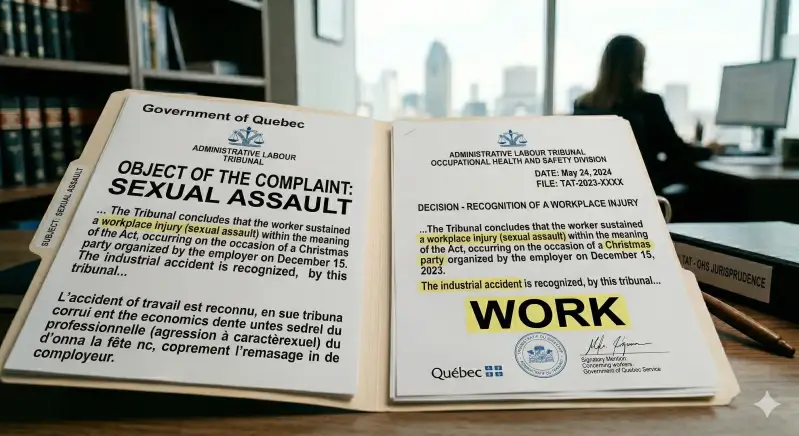
A data analyst was sexually assaulted at her home by a consultant employed by her employer, after a company party where alcohol flowed freely and no one ensured that employees got home safely. The Administrative Labour Tribunal recognized the occupational injury — and flatly rejected the myths that still weigh on assault victims.
What happened — the facts as found by the Tribunal
On March 18, 2022, Corporation Interactive Eidos — a video game development company employing between 150 and 180 people — held a party at an Old Montreal hotel to mark the launch of a new game and boost team morale. About 80 people attended, employees and consultants alike. Upon arrival, everyone received a glass of kir royal. Then, five drink coupons per person, redeemable for alcoholic beverages. By the end of the evening, the director of communications — herself visibly intoxicated — was handing out the remaining unclaimed coupons to whoever was still there. No one was monitoring alcohol consumption.
Laetitia De Sousa found herself in a state of advanced intoxication. She felt very unwell, struggled to stay on her feet, and asked aloud whether anyone could walk her home. A consultant — someone she barely knew — offered to do so. They left the hotel together, first on foot, then by Uber. At her apartment, she invited him in. What followed, the Tribunal found, was a violent sexual assault with no ambiguity whatsoever regarding the absence of consent.
"These are myths and stereotypes that have no place in our justice system."— Administrative Judge Véronique Emond · De Sousa v. Corporation Interactive Eidos, 2026 QCTAT 4, para. 34
The consultant did not testify before the Tribunal. Ms. De Sousa, despite some gaps in memory due to alcohol, gave testimony the Tribunal found precise and credible. The employer did not contest that the events occurred.
The CNESST had denied the claim — the TAT reverses the decision
In her initial claim, the CNESST denied recognition of an occupational injury. The rationale: the employer had no control over an assault that occurred at the worker's home, after the party had ended.
Nearly four years later, Administrative Judge Véronique Emond reversed that decision. She concluded that the events were in direct continuity with the professional sphere — and that it was precisely the employer's failure to control alcohol consumption and the complete absence of a safe-departure plan that created the conditions for the assault.
In 2024, Quebec's legislature amended the AIAOD to introduce article 28.0.1, creating a presumption in favour of workers who are victims of sexual violence committed by their employer or a worker whose services the employer uses. This 2024 law to prevent and combat psychological harassment and sexual violence in the workplace also extended the filing deadline for sexual violence claims to two years. Ms. De Sousa sought to benefit from this presumption.
The Tribunal refused to apply it: the events giving rise to the dispute occurred in 2022, before the provision came into force. In the absence of an express transitional provision, the law does not apply retroactively. The worker had to prove her case under the law as it stood at the time — which she succeeded in doing.
The three pillars of the Tribunal's reasoning
An unforeseen and sudden event — objectively traumatic
In cases of psychological injury, case law requires an objectively traumatic event that falls outside the normal and ordinary course of work. A violent sexual assault clearly meets that threshold. The nature of the acts committed is, on its own, sufficient to establish this character.
Arising out of work — no break in the continuum
This was the heart of the dispute. The employer argued it had no control once employees left the party. The Tribunal rejected that argument. Ms. De Sousa never transitioned from the professional sphere to the personal sphere: it was the state of vulnerability created by the employer — alcohol served without oversight, no safe-departure plan, no verification of any kind — that directly enabled the assault.
Causal link — the diagnosis flows directly from the event
The recognized diagnosis is acute anxiety disorder. The work stoppage was contemporaneous with the assault. Ms. De Sousa reported suicidal thoughts in the days that followed, and has since suffered from eating disorders, sleep disturbances, and severe relational anxiety around men. She has been unable to return to any workplace setting, and resumed her studies remotely to avoid group environments. The causal link was established without difficulty.
What the employer did wrong
On the psychological harassment claim, the Tribunal acknowledged that the employer responded reasonably promptly once informed: it terminated the consultant's contract within days, without questioning Ms. De Sousa's account. On this specific point, the employer met its obligation to put a stop to the harassment.
But on the obligation to prevent harassment, the picture is different.
The employer has had a psychological harassment prevention policy since 2019. Yet no evidence was presented that a reminder of this policy was given to attendees before the party. More critically: no witness confirmed that the consultant — who had been working full-time at the company for several months — had ever received a copy of the policy or been trained on the employer's expectations.
On alcohol management: five coupons per person, plus a kir on arrival, with no real monitoring mechanism. By the end of the evening, the director of communications — intoxicated herself — was handing out leftover coupons to whoever remained.
On safe departure: an Uber coupon was reportedly emailed to employees that afternoon — but the employer could neither confirm the date of that email nor produce it as evidence. No sober person verified how each attendee was getting home. No breathalyzer check, no designated monitor at the door. Ms. De Sousa, far too unwell to locate a promo code on her phone, asked out loud for help getting home safely — and it was the consultant who stepped in.
"It was the employer's poor orchestration of the event that led the worker to leave the hotel while unable to make informed decisions, in conditions that endangered her health and safety."— Administrative Judge Véronique Emond · 2026 QCTAT 4, para. 159
The question of consent — what the Tribunal stated clearly
The employer had suggested that Ms. De Sousa bore some responsibility for her situation by choosing to drink. The Tribunal dismissed this without hesitation: blaming her alcohol consumption, or any behaviour prior to the assault, is rooted in myths and prejudices that the justice system must now firmly reject.
On consent, the judge was equally unambiguous: inviting someone into your home does not constitute consent to sexual activity. Consent must be given at each stage. Ms. De Sousa said no multiple times, clearly and unequivocally. Moreover, her advanced state of intoxication would have, in any case, rendered her incapable of giving free and informed consent.
"Blaming her alcohol consumption — as well as any behaviour prior to the event — is rooted in myths and prejudices that must at all costs be kept out of our analysis."
— Administrative Judge Véronique Emond · 2026 QCTAT 4, para. 161What this decision means for employers
This ruling sends a clear signal: an employer's responsibility does not end at the door of the venue. Providing alcohol without oversight, failing to ensure a safe departure for employees, failing to brief consultants on the harassment policy — these are failures that can engage employer liability, even for events that occurred long after and far from the party itself.
The concept of continuity applied by the Tribunal is broad: as long as the victim's vulnerability flows directly from conditions created by the employer, the accident arose out of employment — regardless of where it physically occurred.
Organizing a social event creates concrete obligations: manage alcohol consumption, ensure a safe way home for all attendees, remind everyone of the harassment policy before the event, and make sure that contractors and consultants are equally informed of workplace expectations. An Uber coupon sent by email in the afternoon is not enough — especially if no one verifies that employees are in any condition to find it and use it when they need to leave.
The obligation to prevent psychological harassment extends to employer-organized social activities, even those held outside the normal workplace and working hours.
Laetitia De Sousa waited nearly four years for the system to recognize what she had experienced. The CNESST had said no. The TAT said yes — and took the opportunity to remind us that myths about sexual assault victims have no place in legal analysis.
Employee safety does not begin at work and does not end at the door of the party.
This article is an editorial analysis based on a public decision. Justice-Quebec.ca is an independent citizen platform. It does not constitute legal advice. The author is not a lawyer.
Ajouter un commentaire
Commentaires