

By Maxime Gagné — Justice-Quebec.ca · March 30, 2026 · Analysis | Institutions
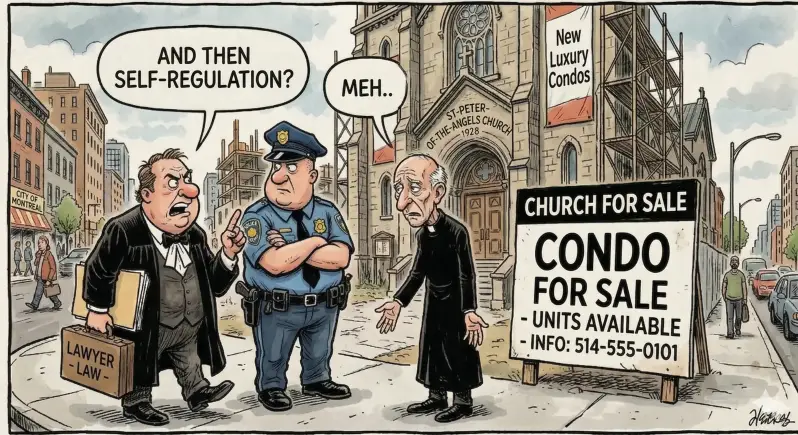
In Quebec, lawyers investigate lawyers. Police investigate police. And for decades, priests investigated priests. We know how that story ends. We refuse to learn from it.
This is not an article against lawyers. Or against police officers. It is an article about an institutional architecture that, when trusted to monitor itself, always produces the same result: protecting the institution comes before protecting the victims. The history of the Catholic Church in Quebec is not a metaphor. It is a documented, quantified warning — one that has so far gone unheeded.
The question is not whether this model is perfect or flawed. The question is: how many victims will it take before we open our eyes?
The Bar: a fortress where the referee wears the same jersey as the opponent
In Quebec, one dogma persists despite the scandals: self-regulation. The idea that only members of a profession can judge their peers. A formula supposedly designed to guarantee technical expertise — that increasingly resembles a mutual protection pact.
For the ordinary citizen who wants to file a complaint against their lawyer, the reality is this: they must go to the Bureau du syndic — a branch of the Bar — which investigates Bar members and decides whether a disciplinary complaint should be filed before the Disciplinary Council. In other words, the referee wears the same jersey as the opponent.
The Bureau du syndic investigates. It is staffed by lawyers who are members of the Bar.
The Review Committee reviews its decisions. Two of the three members are lawyers appointed by the Bar.
The Disciplinary Council hears complaints. Two of its three members are appointed by the Bar.
The ad hoc syndic — appointed when a new investigation is required — is named by the Bar's Board of Directors.
At every stage of the process, the Bar is present. At no stage is an independent civilian body.
No matter how you frame it, the backbone remains the same: at the heart of the system, lawyers still judge lawyers.
And there is more: since April 1, 2020, the same Board of Directors that governs lawyers also manages the insurance fund that decides whether their victims will be compensated. Three roles. One board. No recognized conflict of interest.
The Bar will say safeguards exist. That is true. But these nuances do not change the essential: the primary filtering remains largely internal to the profession. A system can be legal, structured, regulated — and still be deeply unhealthy from the standpoint of public trust.
What actually happens when a citizen dares to file a complaint
They submit their request. They receive an acknowledgement. They wait — months, sometimes over a year. A lawyer decides not to proceed. The citizen has 30 days to bring the matter before the Review Committee. That committee will not meet with them. It will hold no hearing. Its opinion will not be reasoned — the Bar confirms this in its own official texts.
And if that citizen decides to file a private complaint at their own expense — bearing the full burden of proof — and the lawyer is acquitted: the Bar reimburses the lawyer up to $10,000 in legal defence fees. The complainant receives nothing.
Self-regulation always presents itself as a guarantee of expertise. It too often becomes a mechanism for self-protection. The more closed a world is, the more it develops its clan reflexes, its blind spots, its unwritten codes. What insiders call "prudence" looks, from the outside, like complaisance.
— Justice-Quebec.caBy protecting the honour of the profession, the Bar creates — as the Church once did — countless collateral victims: citizens left in financial ruin, lives shattered by professional misconduct that was never sanctioned, files closed with a few-line letter.
The Bar does not publish its complaint rejection rate. This information exists. It is not public. And the government body supposedly overseeing the Bar — the Office des professions du Québec — cannot intervene in individual files and has no direct sanctioning power over the Bar. The watchdog has no teeth. And the watchdog's watchdog simply does not exist.
The police: the problem was acknowledged. It was never truly fixed.
Quebec itself recognized that something was wrong. For decades, when a police officer killed or seriously injured a civilian, another police force conducted the investigation. The 2012 student strike and its many documented cases of police brutality forced the debate. The government created the Bureau des enquêtes indépendantes in 2016.
The very fact that the government had to create the BEI demonstrates something fundamental: it already admitted the old model was no longer defensible. That is more than the Barreau du Québec has ever been pressured to do.
But has the problem actually been solved? Since its creation, the BEI has opened nearly 450 independent investigations. Only two files have resulted in charges from the Director of Criminal and Penal Prosecutions. Not a single one has led to the conviction of a police officer. Zero out of 450. — La Presse, September 27, 2025.
In almost all of its investigations, the BEI must rely on support services from other police forces. The information communicated to the public when an investigation is launched comes exclusively from the implicated police force.
According to a 2025 report by the Ligue des droits et libertés, the majority of BEI investigators are former police officers. One investigator quoted in the report: "It used to be the SPVM running the show — now it's the Sûreté du Québec." All strategic positions are said to be held by former SQ officers who are "trying to import their culture here."
Independence in appearance. Professional solidarity in practice. The BEI is progress — but even that progress remains paralyzed by its ties to the very world it is supposed to oversee.
The word "independent" does not automatically erase ties of culture, career habits, reflexes, and professional networks. If a rule exists to prevent a former officer from investigating their previous force, it is precisely because the proximity problem is real. We are no longer in the crude formula of "police investigating police" — but we remain in a logic where the system continues to draw heavily from the same professional universe to examine its own failings.
The Catholic Church: the mirror no one wants to look at
The parallel with the Catholic Church is not a cheap rhetorical device. It is not about saying all institutions are the same or that all misconduct is equivalent. It is about recalling a very simple institutional lesson: when an organization is granted the privilege of handling accusations against its own members, it almost always ends up minimizing, suppressing, or reframing what should be fully exposed to the public.
- Estimated victims in France alone (CIASE Commission, 2021)330,000
- Estimated victims in Quebec (Radio-Canada compilation)Nearly 10,000
- Class actions and civil suits in QuebecOver 25
- Settlements in 2024 — dioceses of Amos and Trois-Rivières alone$20 million
- Independent public inquiry requested in QuebecRefused in 2019
The mechanism was identical: the institution filtered complaints, conducted its own investigations, defined its own standards of misconduct, and protected its reputation before its victims. When a family came forward with an account of abuse, they were met by a prelate behind a desk: "This is over. We don't speak of it again." That was not an accident. That was the system.
In the case of the Church, it took decades before anyone accepted the idea that a credible investigation had to be independent. When nine Quebec dioceses published the findings of an independent audit in 2022, that gesture was not proof that the internal system had been working. It was proof that no one trusted the internal system anymore.
That is exactly the point that must now be raised about the Bar. Victims of the Bar's disciplinary system have not yet had their public inquiry. Their stories are scattered. Their complaints, filed away. Their cases, closed with a few-line letter. The difference between the Church of yesterday and the Bar of today is not the structure. It is that the Church's scandal finally came to light. The Bar's has not yet.
The real test: not what an institution says about itself, but what oversight it agrees to accept
The Bar will say it protects the public. Police will say they now have independent bodies. The Church, too, long insisted it handled its own affairs. We know how that turned out.
The real test is not what an institution says about itself. The real test is what oversight structure it agrees to accept. And that structure, today, does not pass. Disciplinary justice should never rest on faith. It should rest on independence that is visible, verifiable, and beyond reasonable dispute. Public trust depends not only on the existence of rules — it depends on the certainty that those rules are not administered first and foremost by those with a stake in protecting the institution's reputation.
An independent civilian oversight body, composed mostly of non-lawyers, with autonomous investigative powers over the Bar's disciplinary process.
Annual publication of the complaint rejection rate, broken down by type of misconduct and area of practice.
Reasoned and public decisions from the Review Committee.
An end to asymmetric reimbursement: if an acquitted lawyer has their legal fees covered by the Bar, the complainant should too.
We have already paid too high a price to learn this lesson
We have collectively paid too high a price learning this lesson from the Catholic Church. Refusing to apply it today to the Bar and the policing system is not caution. It is stubbornness.
If the government recognized this bias for law enforcement by creating the BEI — imperfect as it is — why do we still accept it for the Bar? Why does a profession that teaches its students the principle of nemo judex in causa sua continue to apply the exact opposite when it comes to its own members?
What we are asking for is not radical. It already exists in other provinces and other countries. It is simply what any institution worthy of public trust should want: external, independent, and credible oversight. Not to punish. To protect.
In any society, institutional stubbornness always ends up producing the same thing: more victims, more cynicism, and more silence sheltered behind appearances.
Their stories are scattered. Their complaints, filed away. Their cases, closed with a few-line letter. The difference between the Church of yesterday and the Bar of today is not the structure.
The Church's scandal finally came to light. The Bar's has not yet.
Related articles
- Conflict of Interest The FARPBQ: an institutionalized conflict of interest since 2020 (French)
- Oversight Who oversees the Barreau du Québec? The investigation into the OPQ (French)
- Child Protection "They took my children because I was sick" — Systemic failures at the DPJ
- Self-Defence Representing yourself in Quebec — Practical guides
Barreau du Québec — How to file a complaint against a lawyer · Review of a Bureau du syndic decision · Annual Report 2024–2025.
Ligue des droits et libertés — Critical review of the BEI's first three years, December 2025.
Radio-Canada / Enquête — Religious figures allegedly victimized thousands in Quebec, 2020.
Independent Commission on Sexual Abuse in the Church (CIASE) — Final Report, October 5, 2021 — 330,000 estimated victims in France since 1950.
Fonds d'assurance responsabilité professionnelle du Barreau — Private complaint: legal defence fees reimbursed to the lawyer.
Bureau des enquêtes indépendantes — bei.gouv.qc.ca.
Have you experienced a situation involving the Bar's disciplinary system? Would you like to share your story? justice-quebec@outlook.com
DISCLAIMER: This website is not a government site and is not affiliated with the Ministry of Justice or any official body. Justice-Quebec.ca is an independent citizen platform whose mission is to support self-represented individuals navigating the Quebec justice system.
This site does not provide legal advice. All content is for informational purposes only. The author is not a lawyer. When in doubt, consult a lawyer or verify applicable legislation at Légis Québec.
Justice-Quebec.ca | NEQ 2270048103 | justice-quebec@outlook.com
Ajouter un commentaire
Commentaires