

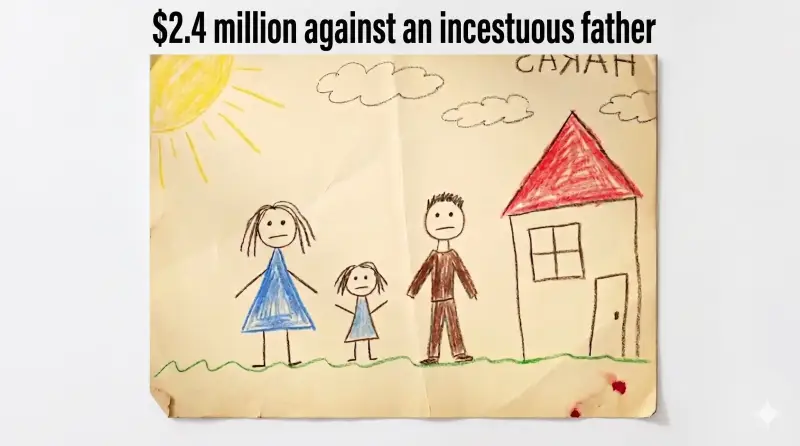
She was five when her father first assaulted her. Ten when he stopped. Forty years later, on April 10, 2026, a court finally ruled in her favour — at the end of a trial where she had to rebuild, from scratch, the evidence that her pediatric psychiatric file had been screaming since 1987. The Superior Court orders her father to pay her $2,420,009. And while she recounted her nightmares to a judge, counsel for the Attorney General of Quebec — the State that is supposed to help victims — was arguing to strip her of $210,000.
J.C. v. M.C., 2026 QCCS 1206. Here's what to take away from it — and why this case should shake the Ministry of Justice to its core.
Five years old. The sofa. The taste of her father's semen.
J.C. was born in 1977. The eldest of three: a sister two years her junior, a brother four years her junior. When she was five, in 1982, her father M.C. began coming to get her at night in the bedroom where she slept with her little sister. He would take her to the bathroom and teach her how to masturbate him. He told her it was because daddy has to get the bad stuff out.
The father would acknowledge three of these visits, all in 1982. The daughter, now an adult and seated in a courtroom at the Longueuil courthouse in September 2025, would say that those visits were only the beginning. That there had been many others, for five years, until she was ten. That he took advantage of Sunday mass while her mother was praying. That countless times, she was forced to perform fellatio — and that because she hated the taste, her father began applying food items she liked to his penis so that she would keep going. That he tried to penetrate her at least once. That he would give her money to buy candy afterwards, which made her brother and sister jealous — they couldn't understand why they weren't entitled to the same gifts.
Before the Superior Court, the father denied everything. He said he had left the house in early 1983, after his wife discovered he was having an affair. That the three incidents in 1982 were the extent of it. That after he left, he no longer saw his children.
Justice Marie-Claude Lalande found the opposite. Not on the basis of a single testimony. On the basis of a medical record that cut across the decades like an indictment — and against the father's word, of which she wrote, in black and white, that his credibility was "weak, if not non-existent."
What her body was saying in 1985, in 1987 — and what no one wanted to read
There are passages in a ruling that should force us to stop and pay attention. This one contains them. The excerpts from J.C.'s medical files — at Sainte-Justine Hospital, then at Charles-LeMoyne Hospital — integrated into Justice Lalande's ruling, lay out a clinical chronology that screams.
Summer 1985: J.C.'s mother files a first report of sexual abuse. J.C. is taken to Sainte-Justine Hospital for an examination — the file records the reason as perforated hymen?, dated July 9, 1985. She is eight years old. Nothing is proven and the report is not retained. No one acts.
Fall 1985 and spring 1986: two further reports are filed for physical abuse. The Youth Protection Services begin their involvement in the summer of 1986.
March 1987: the incestuous situation is finally recognized by Youth Protection. In July 1987, the father agrees to leave the house.
April 6, 1987: new consultation at Sainte-Justine. In the file: The father asks his daughter to drink "white liquid" from his penis — touching young vulva — penetration. She is nine years old.
Monday, October 26, 1987: J.C. threatens to hit her brother and sister with a hammer. Her aunt takes her to Charles-LeMoyne Hospital. The general practitioner, Dr. Bruno Lussier, decides to keep her under observation. She is then hospitalized in pediatric psychiatry. She will stay there for six months. Dr. Jean Péloquin, who takes charge of her, writes that the incestuous relationship with the father allegedly lasted for several months.
December 2, 1987: the family's situation is presented to the court. Contact between father and daughter must henceforth be supervised. The three children will eventually be placed in foster care. The mother, the file notes, has been unable to protect them.
1990: during another hospitalization, J.C. fills out a patient death form herself and announces that she is going to cut her veins. She is thirteen years old.
Before all this, there had been the signs no one connected. Between 1983 and 1987, the medical files document vaginitis, vulvitis, urinary tract infections, vaginal discharge, burning of the vulva — a list that leaves no doubt about what was happening at home. School report cards where, as early as kindergarten, the teacher writes that the little girl blames herself very often. The following year, another teacher notes that she is often aggressive with her friends. Later, it will be recorded that she steals snacks and then offers gifts to be forgiven.
At Charles-LeMoyne Hospital in 1987, medical staff note that the ten-year-old girl accumulates magazines with sexual content, that she is charming, provocative, that she puts a foot on the penis of men she encounters, that she sexualizes everything, the slightest word, the slightest phrase. A ten-year-old child. She tells staff that if she can't find a well-paying job later in life, she'll become a prostitute.
Her father has just acknowledged three incidents in 1982. Nothing else, he swears. Everything that came before, everything that came after, everything the doctors wrote, everything the teachers observed, everything the Youth Protection services eventually documented — according to him, none of it is his doing.
Justice Lalande points out a detail that single-handedly demolishes the father's version. In a note from the child's psychiatrist dated May 15, 1985, the doctor indicates, after a meeting with the parents, that M.C. spends approximately 20 hours per week with the family and sometimes sleeps there. In other words: in 1985, two years after his supposed definitive departure, the father was still at home the equivalent of half a full-time job.
The criminal file that vanished
Around 1995, the father was sentenced to 18 months in prison. This is an established fact — he was subsequently granted a pardon, which itself proves he was incarcerated. But for which specific acts, no one knows anymore.
When J.C., in 2020, finally wants to shed light on her own past, she contacts a Crown prosecutor, who refers her to Detective Sergeant Pascal Sinclair of the Major Crimes Division. The investigator searches. He searches for a long time — several months. He goes through the judicial archives, the correctional archives. The father's conviction file is nowhere to be found. The evidence of his incarceration has vanished.
This disappearance is not an administrative detail. It has direct legal consequences.
Section 101 of the Act to assist persons who are victims of criminal offences and to facilitate their recovery (APVCOR), which came into force on October 13, 2021, provides that a criminal conviction creates a presumption of civil liability in favour of the victim. The victim no longer has to prove the acts themselves, nor the causal link: the conviction speaks for itself. It is a powerful tool, specifically designed to ease the burden on survivors of criminal acts.
But this presumption applies only to the specific offence for which there was a conviction. And since no one knows which one that was, Justice Lalande cannot use it for J.C. The presumption exists, but it applies to nothing — because the State has lost the very thing it was supposed to apply to.
This is where the father found his best argument. He claims his 1995 sentence covered all the acts, including the ones in 1982 that he acknowledges. J.C. argues the opposite: that the conviction only concerned acts that took place during a 1991 visit to Varennes, where he had assaulted her again. Detective Sergeant Sinclair, after months of investigation and after combing through J.C.'s medical files and various other documents including the pardon certificate itself, formally recommends to the Director of Criminal and Penal Prosecutions (DPCP) that charges be laid for the 1982-1987 acts.
The DPCP refuses. Their reasoning: they cannot prove beyond a reasonable doubt that the 1995 conviction did not already cover those acts. The criminal burden of proof is too heavy for a file that no longer exists. The investigator then finds new elements. He goes back to the DPCP. The answer remains the same.
Let's summarize. The father admitted, before the Superior Court, that he assaulted his daughter in 1982. The medical files document assaults up to 1987. And yet, because the State lost its own correctional archives, he became untouchable under criminal law — both for the acts he himself acknowledged and for those his daughter proved.
It is this refusal that pushed J.C. to turn to the civil courts, where the burden of proof is lower (balance of probabilities, not beyond a reasonable doubt). She had to become the investigator of her own past: gathering medical files, school report cards, Youth Protection reports, expert opinions. Rebuilding from scratch the work that a functional justice system should have had archived somewhere.
$250,000 in non-pecuniary damages — and a shattered Quebec ceiling
It's here that the ruling goes beyond J.C.'s individual case and becomes a political document. Because Justice Lalande didn't merely grant compensation. She documented a national inequality.
Non-pecuniary damages — those that compensate for suffering, humiliation, the destruction of self-esteem — have been capped since 1978 by the Supreme Court of Canada at an amount that, indexed to inflation, today reaches $469,801 (as of August 31, 2025). A national ceiling. Supposed to apply everywhere.
Except that depending on the province, we're far below the ceiling. And in Quebec, we're systematically further below than anywhere else.
| Province · Case · Year | Victim profile | Non-pecuniary damages |
|---|---|---|
| Ontario · MacLeod v. Marshall · 2019 | Man assaulted by a priest who taught at his school | $350,000 |
| Alberta · Mrs. R. v. Mr. W. · 2003 | Woman assaulted by her stepfather from ages 8 to 18 | $285,000 |
| British Columbia · C.M.A. v. Blais · 2022 | Woman assaulted at ages 10-11 by a close family friend | $250,000 |
| British Columbia · S.Y. v. F.G.C. · 1996 | Woman assaulted by her stepfather from ages 7 to 18 | $250,000 (equivalent to $490,000 in 2025) |
| Ontario · Zando v. Ali · 2018 | Adult woman sexually assaulted (single event) | $175,000 |
| Quebec · A. c. B. · 2022 | Woman assaulted by her grandfather between ages 13 and 15 | $150,000 |
| Quebec · H.C. c. V. Cl. · 2016 | Woman assaulted by her uncle from ages 9 to 17 | $125,000 |
| Quebec · N.B. c. G.A. · 2021 | Woman assaulted by her uncle from ages 9 to 16 | $100,000 |
| Quebec · Succession de G.P. c. L.P. · 2019 | Woman assaulted by her father from age 8, for 7 years | $100,000 |
| Quebec · Bolduc c. Leclerc · 2022 | Woman assaulted by her uncle at age 10, then raped at 17 | $75,000 |
Let's stop at the fifth line. An adult victim of sexual assault can obtain $175,000 for a single event in Ontario (Zando v. Ali, confirmed on appeal by the Ontario Court of Appeal in 2018). A child assaulted by her own father for five years receives, in Quebec, between $75,000 and $150,000. In Quebec, being raped as a child, by a parent, for years, is "worth" less than being assaulted once as an adult by a stranger in Ontario.
Justice Hamilton of the Quebec Court of Appeal had already made this point in 2020 in O'Brien c. M.H.: compensation for abuse suffered in childhood should be greater than that awarded for abuse suffered as an adult. We are doing exactly the opposite.
Justice Lalande notes it in black and white in her ruling: the amounts awarded 30 years ago by the courts of British Columbia in cases of sexual abuse against young children correspond to the maximum amounts awarded by Quebec courts today — and that's without even being adjusted for inflation.
Translation: a survivor of childhood sexual abuse living in Quebec in 2026 receives less money, in today's dollars, than a survivor in British Columbia in 1996. Thirty years behind. Without even accounting for inflation.
And yet, in 1978, when it set the ceiling, the Supreme Court had been clear:
"All Canadians, wherever they live, are entitled to roughly equivalent compensation for similar non-pecuniary losses."— Justice Dickson, Supreme Court of Canada, Andrews v. Grand & Toy Alberta Ltd., 1978
It is against this state of affairs that Justice Lalande awarded J.C. the $250,000 she was claiming. Not the ceiling. But a signal. An anchor point. A milestone that shifts the Quebec range for years to come.
To support her approach, she relied on R. v. Friesen, 2020 SCC 9, in which the Supreme Court reminds us that child victims of sexual violence can have "their youth and innocence stolen" from them, and insists that the emotional and psychological harm inflicted on a child can be more pervasive and lasting than physical injury.
$2.16 million for a life destroyed before it even began
The actuarial evidence is damning. Employability expert Linda Cameron establishes that J.C. could have, but for the assaults, earned on average $103,000 per year over her working life (in 2024 dollars, at career maturity around age 45). Actuary Julien Perreault calculates the loss on this basis. Due to her permanent sequelae, J.C. will only be able to work half-time for the rest of her life.
Past loss of income: $809,423
Future loss of income: $1,208,143 — residual half-time income of $50,000 in 2024 dollars until retirement.
Future goods and services: $29,089
Management fee provision: $113,354
Non-pecuniary damages: $250,000
Punitive damages: $10,000 — amount limited by the father's financial precariousness, symbolically important.
Total: $2,420,009 — to which is added a separate order of $121,534.07 that the father must reimburse to the Attorney General of Quebec for sums already paid to J.C. by IVAC.
Dr. Marie-Hélène Saint-Hilaire, a psycho-legal expert specializing in the psychophysiology of trauma, offers a diagnosis that justifies these figures: complex post-traumatic stress disorder with comorbidities since age five, major depressive disorder, hypervigilance, Stockholm syndrome, dissociative disorder, and a 50% anatomophysiological deficit. Her expert opinion is uncontradicted.
The scandal within the scandal: when the AGQ argues against the victim it claims to support
We need to stop here. Because what follows is the passage of the ruling that should be the subject of a question in the Blue Room in the coming weeks.
During the proceedings, J.C. had already obtained $210,000 from her father. When he was about to sell his residence, J.C. had the reflex to have a pre-judgment seizure carried out on the property. The residence was sold on October 15, 2024. The father paid her $210,000 as partial payment of her claim. The written agreement explicitly stated that J.C. was waiving none of her rights.
The Attorney General of Quebec — who represents the Minister, and thus the Quebec State — intervenes in the case because the Direction générale de l'indemnisation des victimes d'actes criminels (DGIVAC) has already paid $121,534.07 to J.C. since the start of her claim, and the State wants to recover that money from the father. So far, nothing unusual: this is precisely its role as subrogee.
But the AGQ decided to go further.
The Attorney General asked the court to recharacterize the $210,000 already paid by the father as "non-pecuniary damages" — that is, as compensation for suffering, permanent sequelae, psychological destruction.
Why? Because under APVCOR, J.C. is entitled to a lump sum from IVAC for her permanent sequelae — a sum that has not yet been paid and whose amount has not yet been determined (sections 36 to 41 of APVCOR). And section 33 of the same Act prohibits the cumulation of compensation for the same type of injury.
Concrete translation: had the court sided with the AGQ, the $210,000 that J.C. wrested from her father would have been deducted from the lump sum that IVAC will one day have to pay her. The more she manages to get from her aggressor through her own efforts, the less public aid she receives. The State would have saved up to $210,000 — at the expense of the very victim it is supposed to be helping to recover.
Justice Lalande did not let it pass. She devotes several pages of her ruling to this manoeuvre and responds with a coldness that amounts to a slap.
"The Court wonders about the reasons for such a process if one keeps in mind the objective of the Act and the ideal that animated society in putting in place the IVAC compensation scheme."— Justice Marie-Claude Lalande, Superior Court of Quebec
"In insisting on characterizing the sums paid as non-pecuniary damages, the AGQ appears to want to penalize J.C. for having sought reparation from her aggressor by depriving her of financial assistance in the form of a lump sum to which she would have been fully entitled had she not undertaken her civil action."— Justice Marie-Claude Lalande, Superior Court of Quebec
"The message the AGQ is sending by acting in this way appears to be in contradiction with the very foundation of the compensation scheme for victims of criminal acts, which is to bear the social risk that crimes against the person represent and to assume their consequences, rather than abandon victims to their fate."— Justice Marie-Claude Lalande, Superior Court of Quebec
Let's re-read that last sentence. A superior court is writing, in an official ruling, that the conduct of the Attorney General of Quebec is in contradiction with the very foundation of the public scheme that he is supposed to embody. In another province, that would be front-page news. In Quebec, it passes under the radar.
Justice Lalande ultimately refused to characterize the sum. She notes, moreover, that neither the AGQ nor the father had taken the trouble to formally request this characterization in their pleadings — they only made the request to the Court verbally.
J.C. will therefore keep her $210,000. And she will, in due course, be entitled to her IVAC lump sum. But only because a judge refused to let the State have its way. And the AGQ will make the same request of the next victim who has the audacity to fight back. Unless we talk about it.
A pardon does not erase a crime
Justice Lalande, in a footnote, takes care to point out — citing the Supreme Court of Canada — that rehabilitation does not have an absolute effect and does not erase the past. A pardon does not deprive the victim of her right to civil reparation. A pardon does not create immunity. A pardon helps fight social stigma; it is not an eraser for the medical records of a ten-year-old child hospitalized in pediatric psychiatry.
We also learned, during the trial, that the father continues, even recently, to try to contact his daughter. On Facebook. Through his own account. Through his sister's account. Through an account in the name of a certain Danielle Dionne. July 28, 2015: "hope you're doing well, I love you.". September 4, 2015: "your children are beautiful, congratulations.". July 15, 2016, via Danielle Dionne's account: "YOU ARE VERY PRETTY, YOU LOOK LIKE AN ACTRESS.". December 31, 2017, via his sister's account: "You know, you have to turn the page.". January 1, 2019: "Very nice photos…". Yet J.C. had explicitly written on February 4, 2016: "Now that I have replied, please respect my choice and stop writing to me."
The court found, on the basis of this documentary evidence, that the father remains insensitive to the harm he has caused his daughter. It is this persistent insensitivity that justified the $10,000 in punitive damages — despite his financial precariousness, despite his old age, despite his prison sentence of old for crimes no one knows exactly which ones anymore.
An imprescriptible claim — the judgment in her pocket for life
One last often-overlooked point, but a critical one for victims. Thanks to a recent addition to the second paragraph of section 2924 of the Civil Code of Quebec, the right resulting from a judgment obtained against the author of a criminal offence covered by APVCOR is now imprescriptible. And even if the aggressor assigns his property, this claim is not discharged by bankruptcy — the parties expressly agree on this point in the ruling.
The Minister of Justice himself explained the objective before the National Assembly on November 20, 2024:
"The idea is to ensure that a victim who goes through the courts will, for her entire life, have the judgment in her pocket, so that when the aggressor becomes solvent, or has the means to pay, she can collect it."— Minister of Justice of Quebec, National Assembly, November 20, 2024
M.C. pleads insolvency. He even raises the possibility of assigning his property. It doesn't matter. If an inheritance, an unexpected gain, or the sale of an asset fills his pockets one day, the conviction remains enforceable. Forever. M.C. is 75 years old. He may live for many more years. Every dollar he would touch — inheritance, reimbursement, sale of property — can be seized for the benefit of his daughter. And if the father dies before paying, the debt survives in his estate.
The judgment exists. On paper. She will carry it, as the Minister said, in her pocket for her entire life. And in the meantime, she has her dignity, finally recognized by a court.
What this ruling changes
For victims, for their lawyers, for institutions, J.C. v. M.C. sends four signals that must be heard.
SIGNAL 1 — Even without a usable criminal record, a victim can rebuild all the evidence in civil court and obtain massive compensation. Contemporary medical evidence — hospital files, school report cards, Youth Protection notes — carries as much weight as a conviction.
SIGNAL 2 — The Quebec ceiling of $150,000 in non-pecuniary damages for sexual assault on children has been seriously shaken. $250,000 is now an anchor point. Quebec can no longer ignore that other provinces compensate their survivors better — and that in Canada, an adult assaulted once sometimes receives more than a child assaulted by her father for five years.
SIGNAL 3 — The Attorney General of Quebec has been officially called to order. A Superior Court judge has just written that his role as IVAC's subrogee should not serve to impoverish the victims he is supposed to help recover.
SIGNAL 4 — Thanks to the imprescriptibility provided for in section 2924 para. 2 of the Civil Code of Quebec, this judgment will follow M.C. for the rest of his life. Victims who obtain a judgment today no longer have to chase an insolvent debtor — they have the right to wait.
"In Quebec, the cost of a stolen childhood is being negotiated downward — and the State prefers to save on hospital bills rather than honour its promise to support victims."
— Justice-Quebec.caWhat this ruling demands we face
There are, in this ruling, three intertwined scandals that cannot be separated.
The first is the documented gap between what a survivor of childhood sexual abuse receives in Quebec and what she would receive elsewhere in Canada — or even, in Canada, as an adult. A woman assaulted as a child by her father sometimes receives less than a woman assaulted once as an adult by a stranger in another province. This is not a question of individual justice. It is a question of structural inequality between Canadian women and between categories of victims, tolerated for thirty years, and which Justice Lalande has finally dared to name in a Superior Court ruling.
The second is the disappearance of correctional and judicial records in the Quebec system. A man served 18 months in prison in Quebec around 1995. A pardon was issued in his name. But the conviction file is nowhere to be found — to the point that the DPCP refuses to lay new charges because it can no longer know what has already been adjudicated. This disappearance had the concrete effect of neutralizing, for J.C., the presumption of liability in section 101 of APVCOR that the Quebec legislator had precisely created to ease the burden on survivors. How many other survivors are silently running into lost files?
The third is the conduct of the Attorney General of Quebec. The Quebec State — not a private law firm, not a commercial creditor — the State itself, through its attorney, attempted to claw back $210,000 from an incest survivor who had the foresight to obtain a partial payment from her aggressor before IVAC had finalized its own compensation. The judge refused. But the AGQ asked for it. And will ask the next victim who has the audacity to fight back. Unless we talk about it.
APVCOR, adopted in 2021, is officially called the Act to assist persons who are victims of criminal offences and to facilitate their recovery. That's the very title of the Act. Someone may need to remind the Ministry of Justice what the words assist and facilitate actually mean.
J.C. waited decades for a civil court to say out loud, in an official document, that her father had destroyed her childhood.
During all those years, her medical file existed. Her school report cards existed. The Youth Protection reports existed. Her pediatric psychiatric hospitalization existed. What was missing was an adult willing to connect the dots.
Today, that adult exists. Her name is Marie-Claude Lalande. And her ruling, whether read or not by the elected officials who administer our compensation scheme, will stand as a patient, documented, imprescriptible indictment.
J.C. c. M.C., 2026 QCCS 1206 — Superior Court of Quebec
- Victims of crime Practical guides to the law — Your rights in Quebec
- Investigations Investigation files — Justice-Quebec.ca investigations
- Testimonials Citizen files and testimonials
Counsel on file: Me Megan Lapointe and Me Florence Rodrigue, Juripop (plaintiff) · Me Raphaël Paquin, Lavigne Anctil Mercier (defendant) · Me Marie-Philippe Tanguay and Me Andrea Alary Hoffman, Bernard Roy / Justice-Québec (Attorney General of Quebec)
Legal references: Civil Code of Quebec, ss. 1457, 1607, 1608, 1611, 1621, 2924 para. 2 · Charter of Human Rights and Freedoms, CQLR c. C-12, ss. 1, 4 and 49 · Act to assist persons who are victims of criminal offences and to facilitate their recovery, CQLR c. P-9.2.1 (APVCOR), ss. 1, 32, 33, 36 to 41 and 101
Case law cited by the Court: Andrews v. Grand & Toy Alberta Ltd., [1978] 2 SCR 229 · Ter Neuzen v. Korn, [1995] 3 SCR 674 · Québec (Curateur public) v. Syndicat national des employés de l'hôpital St-Ferdinand, [1996] 3 SCR 211 · R. v. Friesen, 2020 SCC 9 · S.Y. v. F.G.C., 1996 BCCA 6597 · MacLeod v. Marshall, 2019 ONCA 842 · C.M.A. v. Blais, 2022 BCSC 214 · Mrs. R. v. Mr. W., 2003 ABQB 50 · Zando v. Ali, 2018 ONCA 680 · O'Brien c. M.H., 2020 QCCA 1157
Resources for survivors of sexual assault: Provincial helpline for victims of sexual assault — 1-888-933-9007 (24/7, bilingual, confidential and free) · CALACS — Regroupement québécois des centres d'aide et de lutte contre les agressions à caractère sexuel · CAVAC — Centre for Assistance to Victims of Criminal Acts · IVAC — Crime Victims Compensation, 1-800-561-4822
This article is editorial analysis based on a public court ruling. The ruling is subject to an anonymization order; the parties are designated as J.C. and M.C. Justice-Quebec.ca is an independent citizen platform. This article does not constitute legal advice. The author is not a lawyer.
If reading this article has stirred up traumatic memories, you are not alone. The Provincial helpline for victims of sexual assault is available 24 hours a day, 7 days a week, at 1-888-933-9007. The call is confidential and free.
Ajouter un commentaire
Commentaires