
By Maxime Gagné — Justice-Quebec.ca · March 25, 2026
There is an image. The one projected by TV series, law firms recruiting on university campuses, and sometimes by the institutions themselves: the brilliant, well-paid, respected lawyer who makes a difference. It is on this image that thousands of students commit each year to one of the most demanding paths in the Quebec education system.
What nobody clearly explains to them is at what cost — and what they will find at the end of the road. The data exists. It is public. It is simply rarely gathered in one place.
The path: a documented obstacle course
Before arguing a single case, the future Quebec lawyer must complete a law degree of at least three years, the professional training program at the École du Barreau du Québec, the bar exams, and a mandatory six-month articling position — and only then take the oath. A minimum of four to five years. For some, with master's degrees or specializations, considerably more.
What is striking is that each of these steps constitutes an obstacle in itself — not in the sense of a formative challenge, but as a series of filters whose human consequences are rarely documented publicly.
The Bar exam: when official numbers are alarming
The Bar exam is described by those who have taken it as an experience of extreme stress. The historical average pass rate from 2005 to 2023 is 64% on the first attempt and 79% after two tries — meaning one in three students fails on their first attempt, after months of intense preparation.
Some sessions have been particularly severe. In winter 2022, nearly half of students failed the regular final evaluations, sparking a public debate about the School's pedagogy. What makes the situation even more troubling: students who followed the preparatory courses recommended by the School sometimes showed higher failure rates than those who had not — a statistical anomaly without a convincing explanation.
- McGill University — long program (2022-2023) 100%
- Université de Sherbrooke — top of rankings (2023-2024) 88%
- Université de Montréal — 30% of Bar enrolment (2023-2024) Not published separately
- University of Ottawa — bottom of rankings (2021-2022) 61–67%
- Overall Block 1 pass rate after two years — 2023-2024 cohort, all universities combined 88%
Two students who worked equally hard, but came from different faculties, do not start from the same position. Access to the profession depends in part on which university was attended — a reality that neither universities nor the Bar highlight during recruitment periods.
Articling: a narrow door, sometimes unpaid
Suppose you passed the exams. You still need to find a mandatory six-month articling position before you can be called to the Bar. And that is where a second reality sets in.
Unlike other regulated professions, it is the student who must find their own employer. This dynamic creates a structurally unbalanced power relationship: some students accept precarious conditions out of fear of not being able to complete their training. The Young Bar of Montreal has been sounding the alarm for years: 25% fewer young people were finding articling positions, according to data compiled before 2020, and competition for spots remains intense.
Before 2018, some articling students were paid as little as $250 per week — well below the minimum wage regardless of the year considered (between $414 and $480/week for 40 hours depending on the year) — and one in ten received no compensation at all. It was only in 2018 that the École du Barreau decided to stop posting positions paying less than $480 per week. Since then, conditions have improved significantly: according to Droit-inc data from February 2026, articling salaries at major Quebec firms nearly doubled over ten years, rising from $679 to $1,158 per week on average (Droit-inc, February 2026, primarily Montreal firms), and unpaid articling positions represented less than 0.4% of cases in 2025. These improvements are real — but the shortage of positions persists. A major firm like Osler reportedly received between 400 and 500 applications per year to offer only 6 to 8 articling positions — according to data reported by specialized legal media.
According to the Young Bar of Montreal (internal report, circa 2019), the proportion of newly called lawyers receiving a job offer from their principal had decreased by 12 percentage points over a decade. The door to the profession is not only narrow — it sometimes closes in the face of those who gave everything to reach it.
Since 2023, the École du Barreau has revised its professional training program by integrating a mandatory legal clinic — a reform aimed at enriching practical experience before articling. It is a step in the right direction. But it does not resolve the shortage of positions or the power imbalance between students and employers.

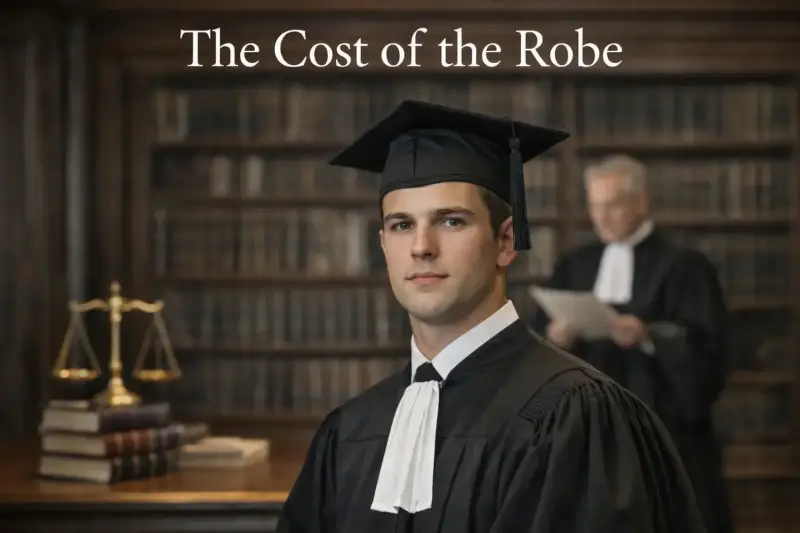
Photo: illustration — law student during Bar exam preparation.
Mental health: an invisible cost, alarming numbers
Mental health in the legal profession is discussed more and more. But the data, when looked at directly, goes well beyond what could be called "normal stress."
A survey conducted by the Association of Students of the Montreal Bar School, with 200 student respondents, found that 8 in 10 students suffered from significant psychological distress, and 6 in 10 showed a level of well-being comparable to depression — 5 of them with significant depressive symptoms. These are not already fragile individuals: this is an entire cohort, in the middle of their training.
"Half of young lawyers suffer from psychological distress. Beyond awareness and resources, what is needed is a culture change within our profession."
— Young Bar of MontrealThis distress does not disappear upon being called to the Bar. In 2022, more than half of Canadian lawyers reported experiencing psychological distress and professional burnout, according to a national study of 7,300 legal professionals. The Barreau du Québec itself acknowledges that lawyers are among the professional groups with the highest risk of burnout, anxiety, depression and substance abuse.
Why does this culture persist? Because in a regulated environment, admitting psychological vulnerability can frighten those who fear being sidelined. Approximately 40.4% of legal professionals said they had needed help without seeking it — citing fear of stigma, of no longer receiving interesting files, or of colleagues finding out. This is not an accident. It is the predictable result of a system that values performance, punishes vulnerability, and does not equip its members to face the reality it imposes on them.
At the end of the road: a half-kept promise
After all of this — years of study, the exams, the search for an articling position, the sleepless nights — what awaits the newly called lawyer?
The popular image is that of the big Bay Street firms or downtown Montreal offices, senior partners with six-figure salaries. That image exists — but it represents only a minority. According to Robert Half (2026 edition), a first-year lawyer in Montreal earns between $82,620 and $112,200 — a range covering both large firms and small offices and the public sector. At major downtown firms, first-year salaries generally exceed $95,000. But not all graduates join large firms.
According to the Barreau-mètre 2022 data, one quarter of lawyers earned less than $70,000 per year, 44% earned between $70,000 and $130,000, and fewer than one lawyer in ten earned more than $200,000.
On the legal aid side — which represents approximately 75% of criminal cases at the Court of Quebec, according to data from the Commission des services juridiques — the Young Bar of Montreal documented (internal report, circa 2019, not publicly available) that the large majority of private practice lawyers handling legal aid mandates earned less than $50,000 from those mandates per year, with a significant proportion falling below the minimum wage threshold once operating costs are deducted. Lawyers have publicly testified to needing a second job to make ends meet.
Lawyers work an average of 47 hours per week, and exceeding 55 hours during a normal period is not uncommon.
Added to these conditions are structural costs that few prospective students anticipate: mandatory annual dues to the Barreau du Québec (between $1,500 and $2,000), professional liability insurance, office expenses for self-employed practitioners. The "prestige" comes with an operating cost.
The disillusionment is measurable. According to the Young Bar of Montreal (data compiled circa 2019-2022), one in four young lawyers — 25.1% — regularly considered leaving the profession, and 31.6% dreamed of another career. More than half of young lawyers felt their academic training had not adequately prepared them for the realities of practice. These figures, while not available publicly in a single report, are consistent with the broader literature on the subject. This last figure may be the most revealing: not that professors taught law poorly, but that nobody took the time to explain to these students what their lives would actually look like once they put on the robe.
A real achievement — but in a system that must speak honestly
Nothing in this article aims to discourage vocations. Law remains an essential profession, rich in meaning and real possibilities. Lawyers accomplish remarkable work every day — in legal aid, civil rights, business law, child protection.
But choosing to become a lawyer knowing what it truly involves — exams with a high risk of failure, fierce competition for articling positions, relentless hours, pressure on mental health, and salaries that can remain modest for many years — is an informed choice. Doing so on the basis of a mythologized image is another story.
The Young Bar of Montreal itself has explicitly called for students to be better informed about the realities of the job market, and for that to be the responsibility of universities and the Barreau du Québec. This is an important admission: the institutions that train and oversee these professionals have not yet fulfilled their duty of transparency toward those who trust them.
The Quebec legal system sells an exceptional achievement. It often delivers a daily reality of chronic stress, modest salaries and measurable disillusionment.
That is not a reason not to enter. It is a reason to enter with your eyes open.
Related articles
École du Barreau du Québec — Block 1 statistical report, 2023-2024 and 2024-2025 cohorts.
Droit-inc — Law faculty rankings at Bar exams 2022-2023 and 2023-2024; articling salary data, February 2026.
Association of Students of the Montreal Bar School (AEEBM) — Mental health survey (200 respondents), reported by Droit-inc.
National Study on the Determinants of Psychological Health of Legal Professionals in Canada, 2022 (7,300 legal professionals).
Young Bar of Montreal — Report on articling conditions and legal aid (circa 2019); ajbm.qc.ca. Note: some JBM data comes from internal reports not publicly available — consistent with secondary sources cited.
Barreau du Québec — Psychological well-being data, Barreau-mètre 2022, PAMBA program.
Robert Half — First-year lawyer salary ranges in Montreal, 2026 edition.
Soumissions Avocat — Lawyer salaries in Quebec, 2025 edition.
DISCLAIMER: This website is not a government website and is not affiliated with the Ministry of Justice or any official body. Justice-Quebec.ca is an independent citizen platform whose mission is to support unrepresented citizens navigating the Quebec judicial system.
This website does not provide legal advice. The information published is for informational purposes only. The author is not a lawyer. When in doubt, consult a lawyer or verify current legislation at Légis Québec.
Justice-Quebec.ca | NEQ 2270048103 | justice-quebec@outlook.com
Ajouter un commentaire
Commentaires