

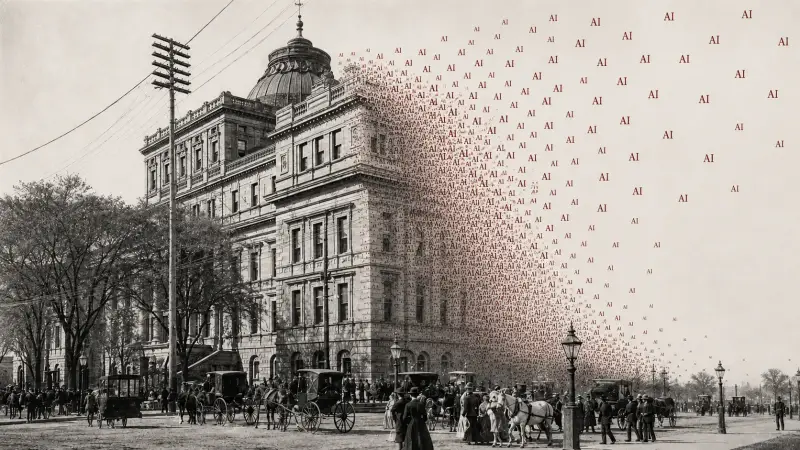
Something is shifting in the relationship between Quebec citizens and their legal institutions. It is not an event, nor a one-off crisis. It is a deep, slow, but inexorable change. On the three pillars collapsing simultaneously — and on the four phases of a cycle that no one has yet been willing to name.
Something is shifting in the relationship between Quebec citizens and their legal institutions. It is not an event, nor a one-off crisis. It is a deep, slow, but inexorable change that affects the Barreau du Québec, the syndic's office, the Professional Liability Insurance Fund, the disciplinary tribunals, and the Ministry of Justice all at once.
The question is no longer whether it is happening. It is how fast — and how violent the transition will be.
Quebec's legal institutions were designed in an era when they controlled both legal knowledge and its distribution. An ordinary citizen who wanted to challenge a decision of the Barreau had to, paradoxically, hire a lawyer to do it. This closed loop gave institutions a de facto monopoly on the production of legal narrative. When you control who can speak about the law with authority, you also control the public narrative about the law.
This architecture rested on three pillars: asymmetry of information, asymmetry of means, and asymmetry of legitimacy. Citizens did not know, could not defend themselves, and were not heard when they tried. All three pillars have been collapsing simultaneously since 2022-2023. And 2026 is likely the year that collapse becomes publicly visible.
AI is fundamentally changing the equation
For centuries, law has been a discipline of accumulation. To properly defend someone, you had to have read, memorized, and mentally indexed thousands of decisions, doctrines, and procedures. That accumulation was the principal justification for legal fees. You don't pay for the lawyer's time that day — you pay for the twenty years it took them to be able to answer you in two minutes.
A general-purpose legal AI now accomplishes in a few seconds what used to take fifteen years for a human to become capable of doing. Not with the same finesse. Not with the same judgment. Not with the same reliability at the edges. But with a quality that is largely sufficient for 70 to 80 % of everyday legal situations. And that proportion is rising every quarter.
The numbers confirm the transformation.
But what is at stake goes far beyond internal productivity inside law firms.
The barrier to entry for basic legal reasoning has been demolished. A citizen with a language model and a bit of method can now draft a demand letter, understand a court decision, identify the flaws in an opposing procedure. They will make mistakes — but they are no longer in the total incompetence that historically justified the asymmetry.
And above all, that citizen can now investigate the institutions themselves. Read judgments. Cross-reference disciplinary decisions. Spot patterns of inconsistency. Build a documented narrative. This work — once the preserve of rare specialized journalists and academic researchers — is now accessible to anyone with enough time and method.
Quebec was already weakened before the AI revolution
The Quebec ground was particularly combustible even before AI arrived. Several signals show this.
Before the Supreme Court of Canada, the proportion of leave-to-appeal applications filed by self-represented litigants has ranged between 19 % and 33 % depending on the year — with a historical peak of 33 % in 2016, dropping to 19 % in 2021, then rising again to 28 % in 2022. In civil matters, the federal Department of Justice estimated some years ago that 31 % of parties in civil litigation were not represented by counsel — a figure that reached 35 % at certain levels. In Quebec, the presence of self-represented litigants continues to grow at all levels of court, as university research has documented, notably through the ADAJ project (Accès au droit et à la justice — Access to Law and Justice).
A survey by the Institut québécois de réforme du droit et de la justice (IQRDJ) of 1,250 respondents found that the vast majority of citizens dread facing the justice system on their own. When they end up doing it, it is out of financial constraint, not preference.
Fewer than one in two Quebecers trust lawyers, according to the Léger barometer published in the Journal de Montréal in 2021. Lawyers ranked 36th out of 50 professions, with a 49 % trust rate — behind many other trades that do not, however, claim to be a pillar of the rule of law.
The Barreau du Québec itself has long acknowledged the situation. Back in May 2022, the bâtonnière Catherine Claveau publicly spoke of "warning signs of a real crisis of confidence in Quebec's judicial institutions." She added that the system had reached its limits and that there were real risks of breakdowns and service disruptions.
More recently, in November 2025, a poll commissioned by the Barreau itself revealed that the proportion of Quebecers believing the principles of the rule of law are well respected in Quebec had fallen from:
A drop of 16 points in three months.
When a professional order publicly states that confidence in the rule of law is eroding at this pace, that is a signal no serious analysis can ignore.
The four possible trajectories — and the one that is winning
Facing this paradigm shift, Quebec's legal institutions have only a handful of options. They are not mutually exclusive — in reality, this is probably a sequence already unfolding in front of us.
We were there. Institutions underestimated the speed of the change. They treated AI as an internal productivity gadget rather than as a paradigm shift in the distribution of legal power. That strategic miscalculation has now accumulated two to three years of lag that will be difficult to make up.
We are entering it. Institutions are discovering that they can no longer control the narrative. Their reflex is to use their last remaining monopoly — legal coercion — to try to regain it. Demand letters, injunctions, threats.
This phase is intrinsically losing: the longer it lasts, the higher the cost in legitimacy. Every procedure becomes a public story. Every public story feeds the citizen narrative.
It will come. And it will not be chosen by the institutions concerned — it will be imposed on them by political actors, themselves driven by the erosion of public trust.
The Professional Code, the disciplinary process, the oversight of syndics: all of these are already sensitive files. When enough citizens have personally experienced the institutional machine failing to protect them — and can demonstrate it with documents in hand, thanks to AI — the political pressure will become irresistible.
These reforms could have been proactive. They will be reactive — and therefore harder on the institutions targeted.
This is the long horizon. The institutions that will survive are those that accepted early to transform their role: shifting from guardians of asymmetry to facilitators of transparency.
The professional order of the future, if it wants to remain relevant, will look more like a body supporting legal accessibility than a closed club. Some foreign bars — in the United Kingdom and certain Australian states — have already begun that mutation.
Why Quebec is particularly vulnerable
Several specific factors amplify the tensions here.
The dual civil-law / federal tradition creates layers of procedural complexity that citizens already found opaque before AI arrived. When transparency becomes accessible, protective complexity is exposed for what it is: a rent.
The public protection mandate written into the Barreau's founding statute makes the perception of failure of that mandate politically more toxic here than elsewhere. An institution whose primary mission is to protect citizens cannot afford to be perceived as primarily protecting its members.
The chronically underfunded legal aid system mechanically pushes more citizens toward self-representation — and therefore toward AI tools and citizen platforms. Every budget cut to legal aid is an involuntary accelerator of the transformation.
And there is a specific Quebec cultural factor: a historical distrust of established professional authority, an attachment to popular critique of elites, a press still relatively lively on matters of justice. All of this means that institutional drifts have a harder time staying underground in Quebec than in more deferential jurisdictions.
The most likely scenario
Quebec's legal regulatory institutions will lose significant public legitimacy over the next three to five years. The loss will not be catastrophic or sudden. It will be slow, cumulative, measurable in public trust polls and media coverage.
At some point, probably after a particularly visible trigger event — an individual case breaking into mainstream media, or a major disciplinary scandal — political actors will be forced to act. A commission of inquiry. A reform bill. A ministerial intervention.
The institutions that started reforming themselves in advance will come out diminished but intact. Those that persisted with the procedural strategy will see their prerogatives transferred to new bodies.
It is a classic cycle in institutional history: organizations that do not reform from within get reformed from outside, and the outside is always harder than the inside would have been.
On AI: the beginning, not the end
What we are experiencing in 2026 is probably only the beginning. The models get better every month. The capacities for document analysis that still required expert supervision two years ago are becoming autonomous.
A citizen platform in 2028 will be able to ingest the entire body of disciplinary decisions from the last ten years and automatically produce a map of inconsistencies. That capacity will no longer be the preserve of laborious journalistic investigations — it will be a commodity.
Which means the power dynamics we observe today are not exceptional. They are the prototype of a pattern that will repeat itself dozens of times in the coming years, in every sector where institutions have accumulated power behind complexity.
And the institutions that relied on it to exist have not yet measured what that means for them.
In closing
No one knows exactly what Quebec's legal system will look like in 2035. But one thing can be stated with reasonable certainty: it will not look like the one we had in 2020.
Institutions have a choice. Either they accept that their legitimacy no longer rests on controlling information, but on the quality of their service to the public. Or they cling to a model of authority built on opacity — and they will, eventually, be replaced.
It simply made it visible.
Sources and references
Barreau du Québec. Press release "Le Barreau du Québec demande un plan d'action pour revitaliser le système de justice," May 27, 2022. Press release on Bill 1, December 3, 2025. Internal poll of the Barreau cited by Le Devoir in "Le Barreau dénonce des mesures autoritaires dans des projets de loi caquistes," November 2025 (75 % in August → 59 % in November 2025).
Supreme Court of Canada. Annual Year in Review 2021 and 2022 — statistics on leave-to-appeal applications filed by self-represented litigants (peak of 33 % in 2016, 19 % in 2021, 28 % in 2022).
Academic research. Bernheim, Emmanuelle and Bahary-Dionne, Alexandra, ADAJ project (Accès au droit et à la justice), report on self-representation before the courts. Canadian Journal of Law and Society / La Revue canadienne droit et société, "La justice et la non-représentation au carrefour de la localisation sociale," vol. 36, no. 3.
Public opinion surveys. Institut québécois de réforme du droit et de la justice (IQRDJ), survey of 1,250 respondents, cited in Droit-inc. Léger survey for the Journal de Montréal, barometer of the professions inspiring the most trust, January 2021 (lawyers ranked 36th with a 49 % trust rate, out of 50 professions evaluated among approximately 1,000 Quebec respondents).
Studies on legal AI. LexisNexis, survey on generative AI among legal professionals, July 2023 (nearly 80 % believe AI improves their efficiency). McKinsey, study on automation of legal tasks (23 % reduction in time spent on repetitive tasks, cited in the legal press 2024-2025).
Institutional documents. Ministère de la Justice du Québec, Indice québécois de l'accès à la justice, 2022. Plan stratégique 2022-2026 of the Barreau du Québec.
This article is an opinion analysis based on public sources, institutional surveys, and verifiable sector studies. Its purpose is to offer a broad reading of observable trends, not to render a definitive judgment on particular cases. Justice-Quebec.ca is an independent citizen platform for legal journalism. This article does not constitute legal advice. The author is not a lawyer. For any personal matter, consult a member of the Barreau du Québec or the legal aid resources available in Quebec.
Generative AI tools can invent facts, legal provisions, or case law — every quotation and factual claim should be verified by the reader against original sources before being used in any decision-making context.
Ajouter un commentaire
Commentaires