

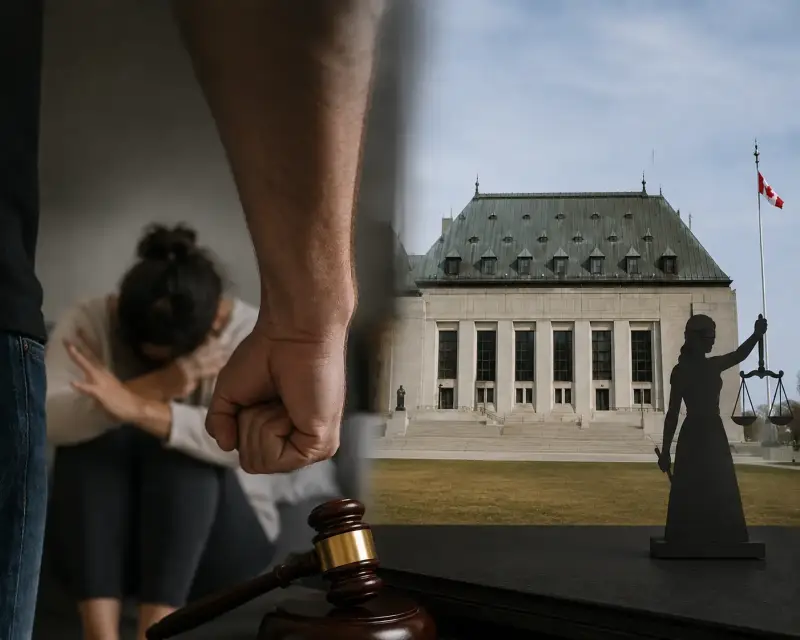
Supreme Court of Canada · Intimate partner violence · Civil liability
Kuldeep Kaur Ahluwalia got married. For sixteen years, her husband controlled her, isolated her, humiliated her, financially deprived her, subjected her sexually. Today, because of her, Canadian law has a new word for what happened to her: a tort. And every victim across the country can now use it.
On May 15, 2026, the Supreme Court of Canada rendered its decision in Ahluwalia v. Ahluwalia (2026 SCC 16). A majority recognized a new common law tort: intimate partner violence. It is the first time such a standalone tort has existed in the country — and it targets precisely what traditional torts (assault, battery, intentional infliction of emotional distress) could not adequately name: coercive control, that prolonged system of domination that strips the victim of her dignity, autonomy and equality.
For Quebec, the ruling does not apply directly — common law and civil law are two distinct systems. But the spirit is already there: our courts have for some years recognized coercive control under article 1457 of the Civil Code of Québec, and the Supreme Court expressly cites that evolution as a source of inspiration.
I — The marriage
Sixteen years of surviving in her own home
The marriage of Kuldeep Kaur Ahluwalia and Amrit Pal Singh Ahluwalia lasted sixteen years. From the very first years, her husband undertook what the courts ultimately called by its proper name: he coerced and controlled his wife in order to break her will and condition her to obey him.
The evidence presented at trial, as described by the Supreme Court, is overwhelming and terribly ordinary: physical assaults. Humiliation. Intimidation. Conduct deliberately designed to inflict emotional distress. Isolation from her family. Abuse used as leverage for sexual purposes. Financial control — even her ability to earn money, keep it, decide what to do with it.
For sixteen years, this woman lived through that. For sixteen years, she could not freely decide what she would do with her career, her family life, her friendships, her happiness. The trial judge would later emphasize that the husband had exploited an additional vulnerability: Ms. Ahluwalia was a racialized woman, newly arrived in the country. And when the marriage finally ended — it was he who filed for divorce — she did something few victims still dare to do in the Canadian legal system: she claimed damages for the abuse she had suffered. In addition to the divorce. In addition to spousal support. In addition to the division of property. Compensation, in civil court, for what he had done to her over sixteen years.
And she won.
The trial judge awarded her $150,000 — $50,000 in compensatory damages, $50,000 in aggravated damages, $50,000 in punitive damages — for what she herself called, by creating the concept, a "new tort of family violence".
II — The detour through the Court of Appeal
Part of the victory erased
The husband appealed. Before the Court of Appeal for Ontario, he made an important concession: he admitted that his conduct triggered his liability under the existing torts (assault, battery, intentional infliction of emotional distress). But he challenged the new tort created by the trial judge. And the Court of Appeal agreed with him on that point.
For the appellate judges, the existing torts were sufficient. There was no need to create a new category. The $50,000 in punitive damages — awarded precisely for the new tort — were removed. The victim lost a third of her compensation.
Ms. Ahluwalia brought the case to the Supreme Court of Canada. The question: should this new tort be created, or are the existing tools really sufficient?
III — The Supreme Court rules
Six judges to three: a new tort exists
The Supreme Court split into three groups. The majority — Chief Justice Wagner and Justices Kasirer, Martin, O'Bonsawin and Moreau, with reasons written by Justice Kasirer — recognized a new tort focused on coercive control. Justice Karakatsanis concurred in creating the tort but would have wanted it to be even broader, also covering isolated acts of violence within an intimate relationship. And three dissenting judges — Côté, Rowe and Jamal — would have left the law as it was.
The result: by six votes to three, the tort now exists. Its formulation, in three elements, is precise.
The three elements of the new tort
First, the abusive conduct occurred in the context of an intimate partnership or in its aftermath.
Second, the defendant intentionally engaged in this conduct — it is enough to prove the intent to act, not a subjective intent to control.
Third, the conduct, from an objective viewpoint, constitutes coercive control: a reasonable person would conclude that it deprives the victim of her dignity, autonomy and equality in the relationship.
— Supreme Court of Canada, majority reasons of Justice Kasirer
Justice Kasirer provides a list — non-exhaustive — of conduct that may constitute coercive control: physical and sexual violence, emotional and psychological abuse, harassment, humiliation, denigration, financial control, stalking and surveillance, isolation, denial of access to employment or recreation, judicial violence, threats to harm children or threats of suicide.
It is, for the first time in the history of Canadian law, a complete legal mapping of what many victims have lived through without being able to put a word to it.
As for Ms. Ahluwalia's damages, the Supreme Court allowed the appeal in part. The $100,000 awarded by the trial judge ($50,000 compensatory + $50,000 aggravated) are maintained — but reclassified entirely as general compensatory damages under the new tort of intimate partner violence. The $50,000 in punitive damages removed by the Court of Appeal are not reinstated, as the record did not contain sufficient evidence to recalculate them. In the end, compensation remains at $100,000 — but it now rests on a legal foundation designed specifically for what Ms. Ahluwalia lived through.
IV — Why the old tools were not enough
The harm was greater than the sum of the blows
To understand why this decision matters so much, you have to understand what the existing torts could not capture.
The classic torts — assault, battery, intentional infliction of emotional distress — are designed for specific events. A slap, a blow, an imminent threat, an outrageous act that causes a provable psychological illness. They operate episode by episode.
But coercive control does not boil down to events. It is a system. A pattern that takes root, thickens, becomes the air the victim breathes for years. The harm done to dignity, autonomy and equality far exceeds each individual aggression taken separately. As the majority writes, the recurring conduct is "greater than the sum of its parts."
"Victims seek to be restored not to the state they were in before each episode of abuse, but to the more complete state of safety, freedom and equality that existed before the recurring conduct began."
— Supreme Court of Canada, majority reasonsIt is this difference that makes coercive control a qualitatively distinct legal wrong. Not aggravated violence. Not repeated assault. Something else. And something that deserves its own name in law.
V — Impact on Quebec
Quebec civil law was already on the path
The Ahluwalia decision rests on common law. Quebec, by contrast, operates under the Civil Code. The ruling therefore does not formally create a new tort in Quebec. But the Supreme Court takes care, in its reasons, to emphasize that Quebec civil law is already well-equipped to respond to this type of legal wrong — and that Canadian common law is partly inspired by that tradition.
Article 1457 of the Civil Code of Québec requires everyone to refrain from causing harm to others through their fault. And the Supreme Court observes that Quebec courts have long recognized that civil liability in a couple can flow not only from isolated acts, but also from "patterns of coercion and control." Justice Kasirer cites several recent rulings from Quebec courts — notably Droit de la famille — 251674 (Superior Court, 2025), where a partner was held liable for coercive conduct, as well as K.M. v. Laplante (Court of Quebec, 2025) and Droit de la famille — 24530 (Superior Court, 2024).
The Quebec Civil Code also expressly frames the obligations of couples. Articles 392 and 521.6 provide that married spouses and partners in a civil union "owe each other respect, fidelity, succour and assistance." These obligations have more than just symbolic weight: they establish a standard of conduct. A spouse who, in defiance of these obligations, adopts conduct that no reasonable spouse would adopt may be held civilly liable for the damages caused under article 1457.
In practice, this means that in Quebec, a victim of intimate partner violence can already — within a divorce proceeding, or in parallel — seek damages for the harm suffered. And the Ahluwalia decision, while not directly binding in Quebec, will very likely give Quebec judges a stronger conceptual framework to quantify and explain the harm associated with coercive control.
VI — Why it matters to you
What this decision concretely changes
Three things are worth remembering, beyond the legal debate.
First. The law now has a vocabulary to name what victims live through. Coercive control is no longer a sociological notion or an activist term — it is a legal category recognized by the highest court in the country. Women (and men, to a lesser statistical extent) who have lived through years of domination without a spectacular blow are no longer forced to reduce their experience to a list of isolated incidents to obtain redress.
Second. Compensation can now reflect the full extent of the harm. When a victim obtains damages for isolated assaults, compensation covers only the proven episodes. With the new tort, the harm to dignity, autonomy and equality — that cumulative harm that persists long after separation — becomes itself compensable, as a distinct loss.
Third. The Supreme Court expressly recognizes that intimate partner violence is a strongly gendered phenomenon. The numbers speak: according to recent Statistics Canada data cited in the ruling, victims of this violence are disproportionately women. A study published in the Canadian Bar Review, recalled by the Court, points to an underreporting rate of nearly 80% — meaning that for every reported case, several others are never reported. And a Quebec study (Gonzalez-Sicilia, Zoom santé, December 2025) underlines that psychological abuse is the most common form in Quebec, but that it is often unrecognized by authorities. The legal system long behaved as though these realities did not exist. This decision clearly says the opposite.
Conclusion
One victim made the law evolve for all the others
It bears repeating, because it is rarely highlighted: it is Kuldeep Kaur Ahluwalia who did what the legislator had not. She lived through sixteen years of coercive control. She launched a civil liability action at the time of the divorce. She carried her file all the way to the Supreme Court of Canada. And on May 15, 2026, the highest court in the country ruled in her favour — and in favour of all the other victims who will follow.
The Ahluwalia decision will not make intimate partner violence disappear. No judicial decision can do that. But it now offers victims a legal word to say what they have lived through, and an avenue of redress designed for that particular harm. It is more modest than a revolution. It is more valuable than a symbol. It is a concrete tool, placed in the hands of people who needed it.
In Quebec, the path had already begun. The Supreme Court has just shed a little more light on it.
⚠️ Are you or a loved one experiencing intimate partner violence?
You are not alone. Help is available.
SOS violence conjugale — listening helpline, 24 hours a day, 7 days a week, free and confidential: 1 800 363-9010 (phone) or by text at 438 601-1211.
In case of immediate danger: call 911.
To find a shelter near you: maisons-femmes.qc.ca (Federation of Women's Shelters) or fede.qc.ca (Quebec Federation of Houses for Women Victims of Conjugal Violence).
Official document
Full Supreme Court of Canada ruling
The full ruling in Ahluwalia v. Ahluwalia, 2026 SCC 16, is available below.
The law now has a word for what they have lived through.
Justice-Quebec.ca · Together, we go further
Decision reference
Ahluwalia v. Ahluwalia, 2026 SCC 16
Supreme Court of Canada · File 41061
On appeal from the Court of Appeal for Ontario
Appeal heard: February 11 and 12, 2025
Ruling rendered: May 15, 2026
Majority (Kasirer J.): Chief Justice Wagner, Martin, O'Bonsawin and Moreau JJ.
Concurrence: Karakatsanis J.
Dissent (Jamal J.): Côté and Rowe JJ.
Editorial note. This article is an editorial analysis based on a public ruling of the Supreme Court of Canada. Justice-Quebec.ca is an independent citizen platform of legal journalism.
Geographic scope. The Ahluwalia ruling rests on common law and creates a new tort directly applicable in common law provinces and territories (all provinces and territories except Quebec). In Quebec, which applies the Civil Code, the decision is not directly binding, but it is very likely to influence the interpretation of Quebec courts in matters of civil liability for intimate partner violence.
The information presented here is for informational purposes only. Justice-Quebec.ca does not provide legal advice. The author is not a lawyer. For any personal question, consult a member of the Quebec Bar or a victim support organization.
Document
Full Supreme Court ruling available for download at the bottom of this article
In Quebec
Coercive control is already recognized under article 1457 of the Civil Code of Québec
Primary source. Ahluwalia v. Ahluwalia, 2026 SCC 16, file no. 41061. Supreme Court of Canada, on appeal from the Court of Appeal for Ontario. Appeal heard February 11 and 12, 2025; ruling rendered May 15, 2026. Majority reasons by Kasirer J. (with Wagner C.J., Martin, O'Bonsawin and Moreau JJ.). Concurring reasons by Karakatsanis J. Dissenting reasons by Jamal J. (with Côté and Rowe JJ.).
Quebec case law cited. Droit de la famille — 251674, 2025 QCCS 4145 · K.M. c. Laplante, 2025 QCCQ 280 · Droit de la famille — 24530, 2024 QCCS 1429 · Droit de la famille — 24915, 2024 QCCA 767 · Ward v. Quebec (CDPDJ), 2021 SCC 43.
Data and studies cited. Statistics Canada, Trends in family violence and intimate partner violence in Canada, 2024 · Institut de la statistique du Québec, Quebec Survey on Violence Committed by Intimate Partners 2021-2022 · D. M. Sowter, "Intimate Partner Violence and Ethical Lawyering" (2024), 102 Can. Bar Rev. 130 · L. Langevin (2023), 57 R.J.T.U.M. 455 · S. Zaccour and M. Lessard, in Contrôle coercitif, PUQ, 2025.
Quebec statutory references. Civil Code of Québec, arts. 392 and 521.6 (obligations of spouses and civil union partners), art. 1457 (civil liability), art. 1974.1 (lease termination for conjugal violence), art. 2926.1 (no limitation period). Charter of Human Rights and Freedoms, ss. 4 and 5 (dignity, privacy).
This article is an editorial analysis based on a public ruling of the Supreme Court of Canada. Justice-Quebec.ca is an independent citizen platform. This article does not constitute legal advice. The author is not a lawyer. If you or a loved one is experiencing intimate partner violence, contact SOS violence conjugale at 1 800 363-9010 (24/7, free and confidential).
Ajouter un commentaire
Commentaires