
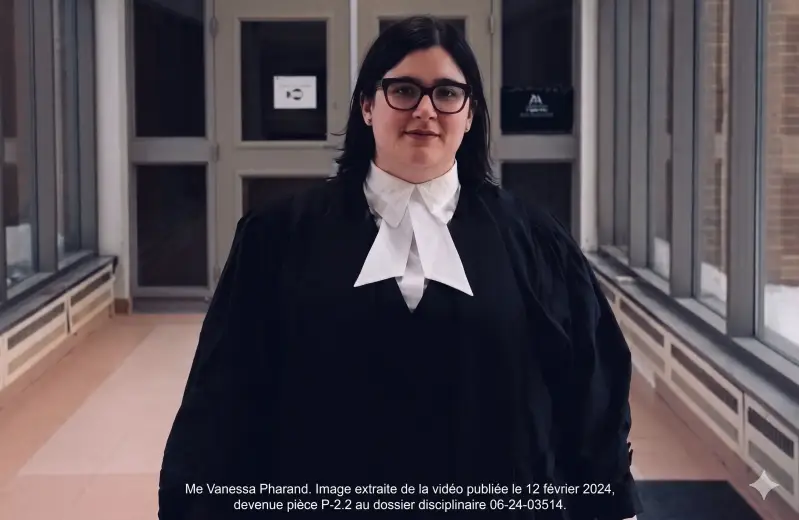
A 58-second video posted on Instagram during her client's murder trial. Twenty-seven months later, a 41-page ruling that sets out, for the first time, what the Barreau expects from its roughly 31,500 members on social media. And a sanction hearing where the syndic is asking for a two-month disbarment — to send a message.
On one side, the assistant syndic of the Barreau, who is asking for a two-month suspension because, in his words, the profession needs "a clear message." On the other, a young criminal defence lawyer from Lac-Mégantic who has already been found guilty, who has already received death threats, and who is now pleading for nothing more than a reprimand. Between them, a 41-page ruling — the first of its kind in Quebec — about to tell the province's roughly 31,500 lawyers what they are and are not allowed to do on Instagram.
The May 12 hearing: deterrence versus leniency
The sanction hearing was held this week at the Disciplinary Council of the Barreau du Québec, before chair Me Isabelle Martel and members Me Julie Bourduas and Me Karl Chabot. The same three who, seven months earlier, found Me Vanessa Pharand guilty of breaching section 129 of the Code of Ethics of Lawyers, in a ruling carrying the citation 2025 QCCDBQ 99 and the file number 06-24-03514. The conviction itself is settled. What is being decided now is the sanction — and the two positions advanced before the Council could hardly be further apart.
For assistant syndic Me Samy Elnemr, the stakes go well beyond the Pharand case: a standard, he argues, must be set for the entire profession. "The point is not to punish, but to send a message," he told the Council. "This was not a slip of the finger. It was planned, deliberate and considered." His request: a two-month temporary disbarment.
For Me Giuseppe Battista, who represents Me Pharand, it is precisely the absence of prior jurisprudence that should counsel restraint. His client, he argues, should not be turned into "the scapegoat for a phenomenon that didn't exist ten or fifteen years ago." His proposal: a simple reprimand.
"She was looking for publicity, and now she has the nerve to ask that it be treated as a mitigating factor." — Me Samy Elnemr, Assistant Syndic, Barreau du Québec
Me Pharand's counsel advanced three mitigating factors: the media exposure of the affair, which in itself amounts to a form of punishment; the fact that his client had only five years of practice when the events occurred; and her remorse.
"I will never again take a risk of any kind that could harm the profession." — Me Vanessa Pharand, at her sanction hearing
Me Pharand testified that, since the video was published, she has received disparaging remarks from colleagues — "Oh, now you'll have time to make another reel," one told her. At the guilt hearing in August 2025, she also said she had received death threats. According to her testimony as reported by Droit-Inc, some messages went so far as to wish on her the same fate as her client's victim.
Her social media accounts are now private.
The guilt ruling: a framework built from scratch
To understand what the Council is now weighing, one has to go back to the October 8, 2025 ruling. Across 41 pages, the three Council members did more than rule on the Pharand case: they sketched out a doctrine meant to apply to the Barreau as a whole.
And they did so without direct precedent. At paragraph 142 of the ruling, the Council explicitly acknowledges that "the case law submitted by the parties relates to situations that do not match the specific facts and evidence in this case." Seven prior decisions are reviewed — Ward, Arseneault, Lapierre, Dugas, Blais, Robert-Blanchard, Pilon — and all are set aside as either insufficient or inapplicable.
The ruling is therefore, in the strictest sense, a piece of judge-made law. The Council builds a norm that did not exist beforehand, and then applies it to a concrete case.
Four pillars, one conviction
The Council structures its analysis around four constituent elements of the video, examined in turn at paragraphs 161 to 187.
First, the hashtags. The Council categorically rejects Me Pharand's account that the hashtags — #avocates, #exposure, #procès, #meurtre, #HTGAWM, #sharp, #classy, #workaholic — were aimed solely at the company Les Rabat-Joies. At paragraph 164, the three members write that the sequence is "troubling with respect to the dignity of the profession, in that it makes clear the respondent wished to publicize her work on her client M.-A. G.'s file, and to put herself forward. The word 'exposure' confirms this."
Second, the music. Me Pharand argued that Gangsta's Paradise, by Coolio, constituted "social criticism." The Council answers, at paragraph 173, that it is "illusory to claim, given the title of the song in particular, that the public will not draw a link between it, her client's criminal trial, and her role as defence counsel."
Third, the gown and tabs. This passage of the ruling is probably the one that will leave the longest mark on the jurisprudence to come:
"A lawyer must wear gown and tabs with the respect and dignity that the exercise of the profession demands, and not as a model in a fashion show. […] The respondent has disregarded her ethical obligations by attaching a profit-driven and commercial character to these working garments." — 2025 QCCDBQ 99, paragraphs 178-179
Fourth, the courthouse. The Council describes as "inconceivable" the idea of a lawyer turning a courthouse "into a film set for the purposes of a social media post in which she stars to increase her popularity." A detail that few media outlets picked up: at paragraph 185, the Council also notes that taking pictures inside the women lawyers' robing room "raises concerns and could be problematic." The conduct is qualified as "inappropriate and illicit."
The five questions every lawyer must now ask themselves
The passage of the ruling that will likely have the greatest practical impact lies at paragraphs 151 to 158. There, the Council sets out what amounts to an operational checklist applicable to every member of the Barreau.
The Disciplinary Council's framework for any social media post
1. Is the post compatible with the values of the profession?
2. Does it harm the image or the dignity of the profession?
3. Could it be considered offensive?
4. What message does the post convey?
5. Could it lead to an interpretation different from the one its author intended?
To which one must add the question of consent from identifiable third parties.
Source: 2025 QCCDBQ 99, paragraph 156.
The Council concludes, at paragraph 158, that "the highest vigilance is required in the use of social media. The professional must use them with discernment and in compliance with their ethical obligations."
What is being established, by way of disciplinary jurisprudence, is a code of conduct that appears nowhere in any formal regulation. Section 129 of the Code of Ethics, which provides the basis for the conviction, is a general provision — it speaks of "honour," "dignity," "reputation," "public trust." It is the Council that, through this ruling, gives those terms concrete content in the realm of digital communications.
The timeline of a 27-month affair
Setting an example: what that tells us
One distinctive feature of this case is worth pausing on. The syndic is not asking for a sanction proportional to any concrete harm suffered by a client or a member of the public. He is, explicitly, asking for a sanction that serves as an example to the profession.
"A two-month disbarment is necessary to make the respondent reflect on what she did, and to send a clear message to the profession that this kind of conduct will be punished. […] A reprimand would shock the public." — Me Samy Elnemr, sanction hearing of May 12, 2026
The stakes therefore go beyond Me Pharand. They concern what the decision will tell the rest of the Barreau about what is tolerable, and what is not, in the digital space. And more broadly, what it will tell us about the place the Order intends to occupy in regulating its members' public speech.
A norm built by the Council itself
It bears repeating: no regulation actually prohibits lawyers from posting videos on social media. Section 129 of the Code of Ethics makes no mention of Instagram, Facebook, or TikTok. What it forbids is failing in a duty cast in very general terms — to preserve "the honour, dignity and reputation" of the profession and to "maintain the public's trust" in it.
It is the Disciplinary Council that, on a case-by-case basis, gives those concepts concrete content. And that is exactly what it is doing, for the first time in the realm of social media, with the 2025 QCCDBQ 99 ruling.
McGill Faculty of Law professor Jakub Adamski, an ethics specialist, told Radio-Canada in December 2024 that "the Barreau du Québec has a duty to send a clear signal when its members engage in inappropriate conduct on social media." The forthcoming ruling will reveal the scope of that signal.
The context one should not forget: the Grenon trial
On February 12, 2024 — the day the video was published — Me Pharand and Me Poliquin were defending their client Marc-André Grenon, charged with the first-degree murder and aggravated sexual assault of Guylaine Potvin, a 19-year-old college student killed in Jonquière in April 2000. At paragraph 25 of the ruling, the Council notes that "the circumstances surrounding the commission of the criminal acts […] are dramatic, serious and of unspeakable violence." At paragraph 209, it speaks implicitly to the victim's family:
"Her conduct in breach of her ethical duties is also incompatible with the respect she owed the victim's family. How are members of that family supposed to interpret the Video? As a lack of consideration and regard for them, for their daughter, and for the tragedy they are reliving." — 2025 QCCDBQ 99, paragraph 209
What this article does not say — and why
This article takes no position on what sanction should be imposed on Me Vanessa Pharand. That decision belongs to the three members of the Disciplinary Council, who heard the evidence and are now deliberating.
What it does try to do is bring forward two dimensions that are rarely found in mainstream coverage: the jurisprudential reach of the ruling for the entire Barreau, and the nature of the norm that is being built — a norm that had no formal existence before, and that the Disciplinary Council itself is defining.
The sanction ruling, when it comes, will tell us how far the Order intends to push that construction.
Legal notes
The October 8, 2025 ruling on guilt may be appealed to the Quebec Professions Tribunal. The sanction ruling, reserved at the time of publication, has not yet been rendered; the positions advanced by the syndic and by the defence reported in this article are submissions, not findings of the Council.
Where things stand
As this article is being published, Me Vanessa Pharand remains a member in good standing of the Barreau du Québec and continues to practise criminal law in Lac-Mégantic, at the firm Fleury Pharand Avocates. She was found guilty, on October 8, 2025, of breaching section 129 of the Code of Ethics of Lawyers.
The sanction hearing was held on May 12, 2026. The Disciplinary Council, composed of Me Isabelle Martel (chair), Me Julie Bourduas and Me Karl Chabot, has reserved its decision. The final ruling is expected within the next few weeks, and will, in all likelihood, become precedent — the first of its kind in Quebec on the matter of professional communications on social media.
And a sanction decision about to tell the province's roughly 31,500 lawyers
what the Barreau now expects of them on Instagram, Facebook and TikTok.
The sanction decision has not yet been rendered. It will set precedent either way.
📄 The full 2025 QCCDBQ 99 ruling is available for download at the end of this article.
Sources and references
Full ruling. Barreau du Québec (syndic adjoint) c. Pharand, 2025 QCCDBQ 99, file no. 06-24-03514, rendered on October 8, 2025 by Me Isabelle Martel (chair), Me Julie Bourduas and Me Karl Chabot. Ruling on guilt — 41 pages. Parallel ruling in the file of Me Karine Poliquin (06-24-03513): acquittal.
Press coverage. Catherine Paradis and Vicky Boutin, Radio-Canada. Solveig Beaupuy, Le Quotidien. Droit-Inc. Patrick Lagacé, La Presse — columns of February 22 and 24, 2024. CKAJ.
Parties. Respondent: Me Vanessa Pharand, member of the Barreau since March 15, 2019, Fleury Pharand Avocates firm (Lac-Mégantic). Complainant: Me Samy Elnemr, assistant syndic of the Barreau du Québec. Defence: Me Giuseppe Battista, Battista Turcot Israel Avocats. Co-respondent acquitted: Me Karine Poliquin (Sherbrooke), defended by Me Pierre Poupart.
Statutory references. Code of Ethics of Lawyers, CQLR c B-1, r 3.1, s. 129. Professional Code, CQLR c C-26, ss. 23, 59.2, 132.1 and 142. Kienapple v. R., 1974 CanLII 14 (SCC).
This article is an editorial synthesis based principally on the 2025 QCCDBQ 99 ruling, supplemented by publicly available press coverage of subsequent stages. Justice-Quebec.ca is an independent citizen-run platform. The author is not a lawyer. The sanction ruling has not yet been rendered.
Ajouter un commentaire
Commentaires