

We've all heard the line in the movies: "Call my lawyer!" But in real life — especially in Quebec — the person you actually need to call is often a notary. The confusion between the two is genuine, widespread, and sometimes expensive. Here is the distinction nobody bothers to explain clearly.
Justice-Quebec.ca | Access to justice · Practical law guides · Understanding the system
Both lawyers and notaries carry the title of "Maître." Both studied law at the same universities — an identical three-year civil law undergraduate degree. That is where the common path ends.
The lawyer heads to the École du Barreau — a professional training program delivered in multiple blocks, followed by a mandatory six-month articling period.
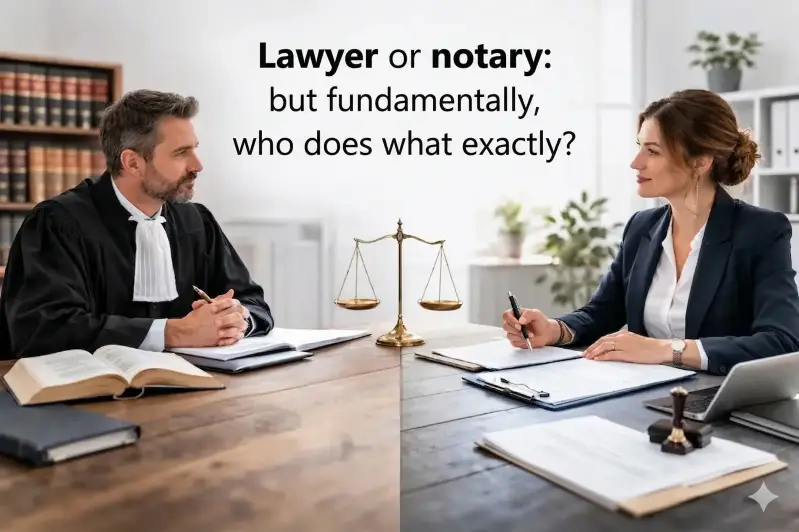
The notary continues into graduate studies: a master's degree in notarial law lasting approximately eighteen months, including a sixteen-week internship, followed by a fifteen-day training program at the Chambre des notaires du Québec.
Two training paths. Two visions of the law. Two ways of being useful.
Because that is where the real difference lies — not so much in what they know, but in the posture each adopts toward their clients, and in the powers the law grants them.
The Lawyer Is There for You — and Only You
A lawyer is, by definition, a legal professional who defends your interests exclusively. Advise, defend, negotiate, contest if necessary.
As a general rule, the lawyer is the one who can plead or act before the courts on your behalf. The law reserves that role for contentious matters — situations involving opposition, conflict, dispute. Arguing your case, examining witnesses, filing court proceedings, negotiating a favourable out-of-court settlement: that is the lawyer's natural territory. The Barreau du Québec offers a search tool to find a lawyer by region and area of law.
You need a lawyer when:
- you are in conflict with someone — a neighbour, an ex-spouse, an employer, a landlord, a business partner;
- you need to defend yourself before a tribunal, whether in a civil lawsuit, a criminal proceeding or a wrongful dismissal case;
- you are negotiating a complex contract and want the terms to tilt in your favour;
- a fundamental right has been violated and you want it recognized.
Lawyers can also draft contracts and advise on business or estate planning. But what they produce remains a private document — valid, but without the special legal force of an authentic act.
The Notary: Jurist of Authenticity and Prevention
The notary occupies a fundamentally different role. When receiving an act between multiple parties, the notary acts with impartiality — taking no one's side, regardless of who is paying the fees. Depending on the mandate, a notary may also advise a single client in certain files, but their primary function is to legally secure agreements and documents in the interest of all parties involved.
That duty of impartiality comes with a power the lawyer does not have. The Act Respecting Notaries grants the notary the status of public officer, allowing them to declare certain documents authentic. A notarial act is not a simple signed contract — it is a document whose original is kept by the notary in a permanent register, and whose evidentiary weight is generally far superior to a private written agreement. In certain specific cases provided by law, particular enforcement mechanisms also attach to it.
Notaries can also represent clients in certain non-contentious judicial proceedings — that is, matters where no one is opposing the application. Homologation of a protection mandate, tutorship, adoption: procedures that go before a judge, but without opposing parties.
You need a notary when:
- you are financing the purchase of a property — in Quebec, a real estate mortgage must be set out in a notarial act;
- you are drafting your will — a notarial will requires no court verification after your death, unlike a holograph will or a will made before witnesses;
- you are planning a protection mandate in anticipation of incapacity;
- you are preparing a marriage contract or civil union agreement;
- you are settling an uncontested estate.
And one fact few people know: a notary can also officiate your civil marriage. The Chambre des notaires provides a directory to find a notary near you.
The Practical Dividing Line: Contentious vs. Non-Contentious
The law names this boundary precisely. The notary intervenes in non-contentious matters — where there is no conflict between the parties. The lawyer intervenes in contentious matters — where there is one.
That is the simplest and most reliable rule for knowing which professional to turn to.
Ask yourself a single question: am I in conflict with someone, or am I trying to secure something?
The answer will tell you almost every time.
The Grey Zones — Where Confusion Actually Happens
Some situations seem to belong to both at once. And sometimes, they do.
The will — Both can draft one. But a notarial will can be executed after death without court verification. A holograph will or one made before witnesses must pass through the court before it can be applied — costing your heirs time and money.
Divorce — An uncontested joint divorce can be prepared by either a notary or a lawyer, both of whom handle the documents and the agreement. But a court judgment is still required to pronounce the divorce — it cannot be done entirely out of court. Once there is disagreement over custody, support or the division of assets, you need a lawyer and a courtroom.
Estates — A notary can guide the settlement of an uncontested estate. If heirs dispute the will, if the will is challenged, if someone claims they were wronged — you need a lawyer.
Business contracts — Both can draft them. But if the contract involves a real estate mortgage — or, in practice, a real estate transfer — a notarial act is unavoidable.
In some complex situations, both intervene: the lawyer protects your specific interests while the notary formalizes and secures the agreement for all parties.
A Quebec Particularity That Is Far Too Often Overlooked
Quebec is one of the very few jurisdictions in North America that maintains a notarial profession this distinct and this powerful. In other Canadian provinces and in the United States, there is no notary in the Quebec sense — only "notaries public," who are essentially commissioners for taking oaths, with no comparable power of authentication.
This is a legacy of French civil law, and it is a genuine advantage: there exists here a category of legal acts whose evidentiary value is particularly strong, less costly to obtain than litigation, and designed to prevent conflicts rather than resolve them after the fact.
In this light, the notary is not merely a document drafter. They are an institution of legal prevention — a resource that other provinces simply do not have.
At a Glance: Which Professional for Which Situation?
| Situation | Professional |
|---|---|
| Financing a real estate purchase (mortgage) | Notary |
| Notarial will (no court verification required) | Notary |
| Marriage contract | Notary |
| Protection mandate (incapacity planning) | Notary |
| Uncontested estate settlement | Notary |
| Civil marriage ceremony | Notary |
| Uncontested divorce (document preparation) | Notary or lawyer |
| Contested divorce (custody, support, assets) | Lawyer |
| Employment dispute | Lawyer |
| Civil or criminal proceedings | Lawyer |
| Hidden defects, neighbour dispute | Lawyer |
| Negotiating a complex contract in your favour | Lawyer |
| Fundamental rights violation | Lawyer |
This table is provided for general information only. Every situation is unique — if in doubt, consult a legal professional.
The Real Mistake Isn't Choosing the Wrong Professional
It is not consulting one at all.
Both can point you in the right direction at an initial meeting. If your situation falls outside their usual scope, they will refer you to the right person. The Quebec legal network — between lawyers and notaries — tends to operate in a complementary rather than competitive way.
And if you cannot afford a consultation, resources exist: legal aid, Juripop, university legal clinics, Article23. Justice-Quebec.ca covers all of them in its guide to the best legal tools for Quebec citizens.
Related articles:
- Éducaloi, CanLII, Article23 and the Rest: The Best Legal Tools for Quebec Citizens
- File a Complaint Against a Lawyer in Quebec
- The Lawyers Who Defend the Most Vulnerable in Quebec
Sources: Chambre des notaires du Québec — Notaire ou avocat? — Barreau du Québec — École du Barreau du Québec — Government of Quebec — Lawyers and Notaries — Act Respecting Notaries, CQLR c N-3 — Professional Code, CQLR c C-26
This site does not provide legal advice. The information published is based on publicly verifiable sources. Justice-Quebec.ca is an independent, non-profit citizen platform.
Ajouter un commentaire
Commentaires