

By Maxime Gagné — Justice-Quebec.ca · April 30, 2026
A special education worker slips on her employer's access ramp, just after finishing two hours of picketing. Workplace accident — or simply a consequence of her union activities? The Quebec Labour Tribunal has now ruled.
In a decision rendered on April 8, 2026, Administrative Judge Valérie Lajoie overturned the CNESST's decision and declared that Ms. Valérie Fortin, a special education worker at CIUSSS Saguenay–Lac-Saint-Jean — Domaine-du-Roy, did indeed suffer an employment injury.
But the most instructive part of the decision is not the outcome. It is the way the Tribunal reframes, in just a few words, the employer's defence strategy: a "false debate."
Fortin and Centre intégré universitaire de santé et de services sociaux du Saguenay–Lac-St-Jean - Domaine-du-Roy, 2026 QCTAT 1485
Quebec Labour Tribunal (Occupational Health and Safety Division)
Region: Saguenay–Lac-Saint-Jean · File: 1365832-02-2404 · CNESST File: 515468213
Administrative Judge Valérie Lajoie · Decision rendered on April 8, 2026
A fall of a few seconds, a debate of several months
On November 22, 2023, around 8 a.m., Valérie Fortin arrives at her workplace. She has been a special education worker at CIUSSS Saguenay–Lac-Saint-Jean — Domaine-du-Roy for several years. She enters through the main door, the one used daily by employees, goes to her desk, and checks her calls.
Around 8:30 a.m., she steps back outside. A strike is underway, and she is to do two hours of picketing with her colleagues, on a section of the employer's grounds set aside for that purpose.
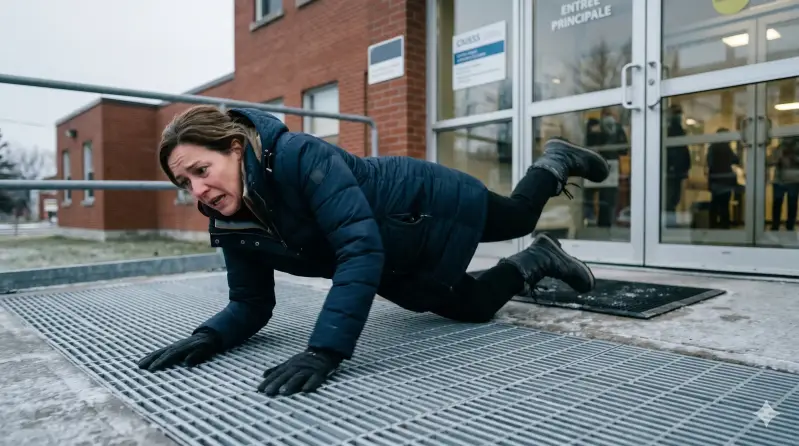
When her picketing time is up, she leaves the group of strikers and heads back to the building to return to her duties. She opens the entrance door, steps onto the metal ramp at the threshold — and slips.
Her feet slide backward. To break the fall, she lands on her wrists, while her shins strike the doorstep.
To avoid the boot-cleaning mat, she stretches her neck to the left — a hyperextension cervical whiplash motion — before her head hits the ground.
Pain, electric shocks, and numbness in her upper limbs appear immediately.
She gets up, reports the event to her employer the next day, and at first tries to manage the pain on her own with anti-inflammatories. But about two weeks after the fall, nausea, dizziness, severe headaches, and visual disturbances are added to her lower back and neck pain. A colleague suggests she go to the emergency room. She presents on December 14, 2023.
The diagnoses come in: lumbar and cervical sprains, mild traumatic brain injury. The following week, her family doctor, Dr. Andréanne Bonin-Carignan, confirms these diagnoses and recommends a work stoppage.
Ms. Fortin files a claim with the CNESST. Refused. Administrative review requested. Refusal confirmed on April 15, 2024. Reason given: lack of evidence to conclude that the injuries occurred by the act of, or in connection with, the work.
It is this refusal that brings the worker before the Quebec Labour Tribunal.
"In connection with work": a notion without legal definition
Section 2 of the Act respecting industrial accidents and occupational diseases defines a workplace accident as a sudden and unforeseen event, attributable to any cause, occurring to a person by the act of or in connection with their work, and resulting in an employment injury.
In Ms. Fortin's case, the first branch is quickly set aside: at the moment she slipped, she was not performing her duties as a special education worker. The accident therefore did not occur by the act of work.
That leaves the other branch — accidents occurring in connection with work. And this is where the analysis becomes interesting, because this notion is not defined in the Act.
Case law has filled this gap. Since the 1995 decision Plomberie & chauffage Plombec inc. et Deslongchamps, rendered by the former Commission d'appel en matière de lésions professionnelles, tribunals have assessed this notion using six criteria:
1. The location of the accident
2. The time at which it occurred
3. Whether the activity engaged in at that moment was paid
4. The existence and degree of authority or subordination of the employer
5. The purpose of the activity engaged in — whether incidental, accessory, or optional to the conditions of employment
6. The connection and relative usefulness of the activity to the performance of the work
None of these criteria, taken alone, is decisive. The tribunal assesses them globally, taking into account the circumstances specific to each case. But as Judge Lajoie reminds us, citing the decision Roberts and Centre d'Hébergement St-Margaret, two criteria occupy a central place: the purpose of the activity engaged in and its degree of connection with the performance of the work.
In other words: what was the activity for, at the moment of the accident, and how closely was it tied to the worker's job?
The line that needs to be drawn is the one between the professional sphere and the personal sphere. In the first, the accident is compensable. In the second, it is not.
The "false debate": the employer's strategy reframed
Before the Tribunal, the employer deploys a predictable line of argument. Rather than discussing the precise circumstances of the fall, it steers the debate toward the strike, the picketing, and union activities. The objective is clear: if the tribunal agrees to view the fall through the lens of the labour conflict, then the event tips into the personal sphere — and the claim collapses.
Administrative Judge Valérie Lajoie does not take the bait. In a single sentence, she resets the frame:
"During arguments, the question of the strike, picketing, and union activities found its way into the employer's submissions. However, the Tribunal considers this to be a false debate, since the evidence shows on a balance of probabilities that the period of picketing or union activities was over at the time of the accident." [Translation]
— Administrative Judge Valérie Lajoie, 2026 QCTAT 1485, para. 28
The precision of the moment becomes decisive here. The evidence establishes that when Ms. Fortin climbs the ramp and falls, her picketing time is over. She has left the group of strikers. She has walked the few metres separating the picketing area from the building. She opens the door. And the testimony is unequivocal as to what follows: as soon as she gets up from her fall, she goes directly to her office and begins working.
The activity she is engaged in at the moment of slipping is therefore not a union activity. It is a professional activity: entering her workplace to carry out her duties.
Applying the six criteria to the facts
Once the false debate is set aside, the tribunal methodically applies the six Plombec criteria to the facts of the case.
The location. The fall occurs on the access ramp of the employer's building, at the main door used daily by employees. "There is no doubt that the accident occurred on the employer's premises," the judge holds.
The time. Although the exact hour remains imprecise, the evidence establishes that the picketing time was over at the moment of the fall. The worker was not yet at her regular work — but she was on her way there.
The pay. The period between 8:30 a.m. and 10:36 a.m. was not at the employer's financial expense. But because the picketing was already finished when the fall occurred, it is possible the worker was being paid at that precise moment. The judge considers this criterion not to be decisive.
Authority. Since the union activities had ended and the worker was making her way to her office, it can be inferred that she was then under the employer's authority. This criterion is also considered secondary in the circumstances.
Purpose, connection, and usefulness. This is where the case is decided. The tribunal analyzes these criteria together:
The activity Ms. Fortin is engaged in when she steps onto the metal ramp consists of going to her office to continue the work she had begun that morning.
The route she travels toward her office is an activity connected to her work as a special education worker, the purpose of which lies in the performance of her duties.
This is useful to the employer.
The tribunal's conclusion: the worker is in her professional sphere at the time of the accident. The event did indeed occur in connection with her work.
The mechanism of injury and the diagnoses
Once it is established that the accident occurred in connection with the work, it must still be shown that this accident actually caused an employment injury. On this point, the medical evidence is clear and uncontradicted.
The tribunal first notes the worker's physical condition at the time: excellent shape, several sports practiced regularly, and coaching of sports teams for many years.
The mechanism of the fall — feet sliding backward, fall broken on the wrists, shins striking the doorstep, cervical hyperextension whiplash to avoid the boot-cleaning mat — is found to be compatible with the diagnoses retained: lumbar and cervical sprains, mild traumatic brain injury.
The tribunal also addresses an element the defence might have used: the worker waited about three weeks before going to the emergency room. But this delay has an explanation. She first took anti-inflammatories, hoping the symptoms would ease. She kept working. Her sports activities, however, were stopped. And her family duties were slowed. When nausea, dizziness, severe headaches, and visual disturbances were added to the pain — about two weeks after the fall — the consultation became unavoidable.
In the absence of a formal medical evaluation procedure under the Act, the tribunal is bound by the diagnoses retained by the physician treating the worker. The conclusion follows: those diagnoses are the consequence of the November 22, 2023 event.
Why this decision matters beyond the Fortin case
From a strictly legal standpoint, the Fortin decision invents nothing. It rigorously applies principles known since 1995 and consistently reaffirmed since. But it illustrates something important for Quebec workers: the precise moment of an accident can change everything.
If Ms. Fortin had fallen while picketing, the analysis would have been very different. The union sphere would likely have prevailed over the professional sphere. But she fell after, on her way back to her office. And it is that difference of a few minutes that separates a denied claim from a recognized employment injury.
The decision also reaffirms an underestimated principle of labour law: going to one's post is part of the professional sphere, as soon as one is on the employer's premises and about to perform one's duties. The simple act of crossing an access ramp, in this logic, is not a trivial gesture of private life — it is a gesture connected to and useful for the work.
"The route travelled by the worker toward her office is an activity connected to her work as a special education worker, the purpose of which lies in the performance of her duties." [Translation]
— Judge Valérie Lajoie, 2026 QCTAT 1485, para. 30Finally, the rejection of the "false debate" sends a signal to employers and their counsel: a claim cannot be defeated by steering the discussion toward a context that has nothing legally to do with the moment of the accident. If the worker is no longer picketing when she falls, picketing carries no weight. The strike may colour the factual backdrop of the day — it does not change the nature of the activity engaged in at the precise moment of the accident.
A decision that reminds us where the personal sphere ends
The Fortin case does not revolutionize occupational health and safety law in Quebec. It confirms a consistent logic: an accident occurring on the employer's premises, just before the worker resumes her position, falls within the professional sphere — even if the employee is not yet officially "at work."
But the decision's contribution lies above all in its methodological precision. Judge Lajoie does not simply apply Plombec — she takes the trouble to explain why the union context, raised by the employer, has no relevance to the analysis. The picketing was over. Period.
For the thousands of workers who slip, trip, or are injured each year on the ramps, stairs, parking lots, or hallways of their workplace, this kind of decision is a valuable reference point. A workplace accident does not wait for you to clock in: it exists from the moment your activity is connected to your job, on your employer's premises, and useful to the performance of your duties.
Information as a lever. Access to justice for all.
Together, we go further.
Editorial note: This article is an editorial analysis based on a public judgment of the Quebec Labour Tribunal. Justice-Quebec.ca is an independent citizen platform for legal journalism.
If you have suffered a workplace accident in Quebec, you can contact the CNESST at 1 844 838-0808. For support, several unions and community organizations offer free assistance to workers in their procedures.
The information presented here is for informational purposes only. Justice-Quebec.ca does not provide legal advice. The author is not a lawyer. For any personal matter, consult a member of the Barreau du Québec or your union representative.
Related articles
- Official decision Fortin and CIUSSS Saguenay–Lac-St-Jean — Domaine-du-Roy, 2026 QCTAT 1485
- Practical guides Practical guides to law — Your rights in Quebec
- Investigation files Investigation files — Justice-Quebec.ca investigations
- Testimonials Citizen files and testimonials
Prior decision overturned: Decision of the Commission des normes, de l'équité, de la santé et de la sécurité du travail (CNESST) following administrative review, rendered on April 15, 2024
Counsel of record: Me Éric Gourde — Alliance du personnel professionnel et technique de la santé et des services sociaux (for the applicant, Ms. Valérie Fortin) · Me Stéphanie Émond — Plourde Avocats (for the respondent, CIUSSS Saguenay–Lac-St-Jean — Domaine-du-Roy)
Case law cited by the Tribunal: Plomberie & chauffage Plombec inc. et Deslongchamps, C.A.L.P. 51232-64-9305, January 17, 1995, B. Lemay (the six criteria for accidents in connection with work) · Roberts and Centre d'Hébergement St-Margaret, 2026 QCTAT 775 (central place of purpose and connection) · Huberdeau and Manoir Tadoussac inc., 2021 QCTAT 5646 (professional sphere vs. personal sphere) · Haciane and B2C contact ltée, 2018 QCTAT 250 (search for the purpose of the activity)
Statutory references: Act respecting industrial accidents and occupational diseases, CQLR c. A-3.001, s. 2 (definitions of "employment injury" and "industrial accident") · Act respecting industrial accidents and occupational diseases, s. 224 (tribunal bound by diagnoses of treating physician in absence of medical evaluation procedure)
Legal notion at issue: Accident occurring "in connection with work" — a notion not defined by the Act, framed by six jurisprudential criteria (location, time, pay, authority or subordination, purpose, connection and usefulness of the activity in relation to the work). Purpose and connection occupy a central place in the analysis.
This article is an editorial analysis based on a public judgment. Justice-Quebec.ca is an independent citizen platform. This article does not constitute legal advice. The author is not a lawyer.
Ajouter un commentaire
Commentaires