

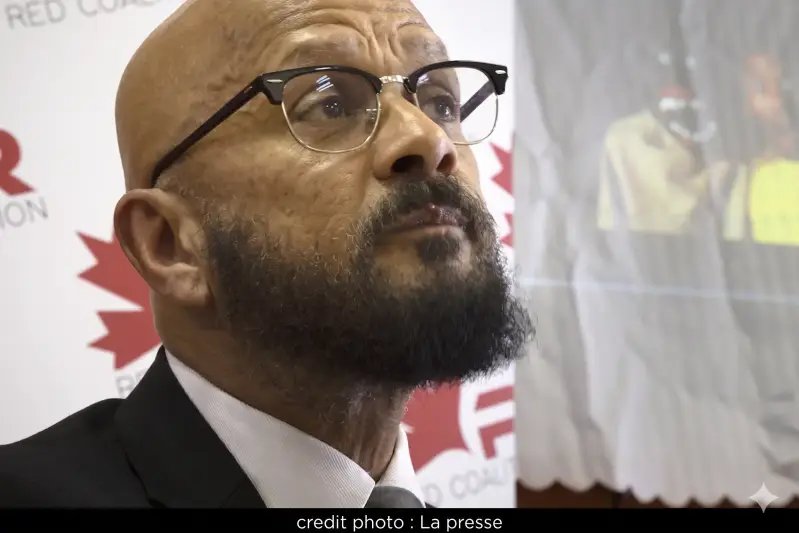
By Alain Babineau, JD/BCL — Contributor, Justice-Quebec.ca · April 2026
We remember the woman from Trois-Rivières who streamed live racist insults against Black, Arab and Muslim people — shared, parodied, turned into memes. We remember the young man who violently insulted a female SPVM officer during a traffic stop — condemned at the National Assembly, denounced by the Mayor of Montréal, singled out for his origins.
Two reprehensible behaviours. Two radically different collective reactions. Why?
Alain Babineau — McGill-trained lawyer and retired RCMP staff officer — explains it to us.
↓ Author-signed PDF version available at the end of the article
I am a retired police officer and staff officer with the RCMP. I spent my career alongside the women and men who do this difficult frontline work, daily exposed to verbal violence, provocations and abuse of every kind. I know the human cost of this profession. I know what it takes, in body and soul, to absorb day after day the hostility of those one is there to protect.
I am also a racialized person. A committed anti-racist and defender of human rights, I have zero tolerance for words and actions that violate human dignity — whatever their source, whatever their target.
This is not a contradiction. It is precisely this dual perspective — that of someone who has lived the realities of police work from the inside, and that of someone who has lived from the inside what it means to be looked at differently, treated differently, judged differently — that allows me to see what so many others choose not to see.
— Alain Babineau
Let us be clear: Insulting a police officer is unacceptable! Holding racist views in public is unacceptable! Both deserve the same indignation. Both deserve the same response.
What I cannot accept is that we choose one and laugh at the other!
Two incidents. Two individuals. Two radically different collective reactions. Why?
In recent months, two cases have shaken Quebec’s social media. In both cases, individuals publicly made hateful, degrading and violent remarks. In both cases, vulnerable groups were targeted. And yet, the reaction of the public, the media and institutions has not been the same at all.
A “pure-laine” Quebecer woman
A woman, a “pure-laine” Quebecer, streams live broadcasts on social media in which she utters, apparently under the influence of alcohol, racist and degrading insults against Black, Arab and Muslim people. She uses vulgar terms to distinguish herself from racialized people. Parents are worried that she works with children from diverse backgrounds.
A young Arab-origin man
A young man of Arab origin, who says he is fully Quebecer, is filmed during a traffic stop violently insulting a female SPVM officer with extreme misogynistic terms. Another video shows him insulting two other officers. He has a criminal record including a fraud conviction in 2025, fines in several cities for insults against police officers, and ongoing investigations.
Both behaviours are reprehensible. Period.
But look at how society reacted to each
In the first case: viral shares, parodies, memes. People mock. Her phrases are quoted as jokes. Comments are amused. And when voices rise to denounce, the reflex is quick: “She’s probably sick. She needs help.” Psychological distress, alcohol dependency are invoked. Compassion is called for. No official condemnation. No documented intervention by authorities. No article in recognized media.
In the second case: unanimous condemnation at the National Assembly. Motions adopted. The Mayor of Montréal speaks of “disgusting” remarks. The SPVM Chief steps in. Journalists question his parents. There is debate about a municipal legal loophole. Regulation is demanded. His behaviour is linked to his origins, his culture, his immigrant status — even though he affirms he feels fully Quebecer.
Let us ask the real questions
Why do we speak of mental illness for one, but never for the other?
As soon as the first woman’s videos circulated, part of the public immediately evoked mental health, alcoholism, distress. But let us ask ourselves honestly: was it ever, even for a moment, publicly considered that the second person could also suffer from behavioural disorders, pathological impulsivity, a problematic relationship with authority? No. Not once. For him, no benevolent diagnosis. No call for compassion. Straight to condemnation, sanction, symbol.
Mental illness serves here as a shield — but only for some. And this shield has a colour / an ethnicity.
Why do the remarks of one make people laugh, while those of the other make them shudder?
This is not new. Quebec has a long memory when it comes to racism dressed up as entertainment. For generations, jokes about “Negroes”, Arabs, Jews, gays and immigrants have circulated in show halls, on radio, on television — often under the cover of popular humour, “rural culture” or “Quebec plain-speaking”. People laughed. People applauded. And anyone who dared complain was seen as someone who “doesn’t get the joke” or who “sees racism everywhere”.
Social networks did not invent this phenomenon. They amplified it, accelerated it, monetized it. Racist “lives” are no longer broadcast on radio airwaves — they are streamed live, liked, shared, turned into memes. The mechanism is identical: shock a minority, make the majority laugh, and call it authenticity.
Laughter is not neutral. It reveals to whom we grant humanity — and to whom we deny the dignity of being taken seriously. When this laughter lasts for generations, it is no longer called humour. It is called complicity.
— Alain BabineauWhy do we associate one with his origins, but not the other?
The second has been presented in many media outlets as “of Arab origin”, even though he says he is Quebecer, as if that explained his actions. His parents have been questioned. Cultural shock has been evoked. But the first — a pure-laine Quebecer from Trois-Rivières — has never been presented as the symbol of a French-Quebec cultural drift. Her actions belong to her, to her alone. So why would his belong to an entire community?
What the law says — and what we carefully forget to distinguish
Insulting a police officer is not a hate crime. It is a violation of a municipal by-law — where one exists. It is reprehensible, it is unacceptable, but it is not the same thing, from a legal standpoint, as targeting an identifiable group with hateful remarks during a public broadcast.
Section 319(1) — Public incitement of hatred
Section 319(1) of the Criminal Code provides that everyone who, by communicating statements in a public place, incites hatred against an identifiable group is liable to imprisonment for a term not exceeding two years.1
Under section 318(4), an identifiable group means any section of the public distinguished by colour, race, religion, national or ethnic origin, age, sex, or sexual orientation.2
However, the other available videos clearly show that the young man insults police officers regardless of gender — men as well as women. His target is not women as an identifiable group based on sex. His target is police authority as an institution. The apparent misogynistic charge in the most viral video therefore does not reflect systematic hatred towards women — it falls within a generalized hostility towards law enforcement, regardless of gender. This finding legally weakens any attempt to qualify his actions as a hate crime under section 319 of the Criminal Code.
In contrast, repeated public broadcasts, in front of thousands of subscribers, explicitly targeting people because of their skin colour, ethnic origin or religion: this is precisely what section 319 targets. And yet, it is the opposite that happens in the collective reaction.
What jurisprudence teaches us
There is in Canada a significant body of jurisprudence on the issue of hateful remarks made against identifiable groups. The ruling in Bou Malhab v. Diffusion Métromédia CMR inc. [2011]3 is particularly relevant here, as it concerns precisely racist remarks made publicly against taxi drivers of Arab and Haitian origin in Montréal.
A radio host had made disparaging remarks about these drivers, accusing them of corruption, incompetence and uncleanliness. The Superior Court had initially ordered payment of $220,000 to the 1,100 drivers targeted. The Supreme Court ultimately dismissed the class action for defamation — not because the remarks were acceptable, but for a procedural reason: the remarks had been “diluted in the crowd” due to the size of the group, making it impossible to prove individualized harm for each member.
What this decision does not say is that such remarks are legal or without consequence. It simply says that the civil route of collective defamation was inapplicable in this specific context. The criminal provisions of section 319 of the Criminal Code remain intact.
R. v. Keegstra: the legitimate limits of freedom of expression
Freedom of expression has limits. In the ruling R. v. Keegstra [1990]4, the Supreme Court ruled that provisions prohibiting hate propaganda constitute reasonable and justifiable limits on freedom of expression in a free and democratic society.
You have the right to shock, offend, disturb. You do not have the right to incite hatred against a racialized, religious or ethnic group.
What this double standard reveals
Racism trivialized when it comes “from our own” is still racism. Misogyny condemned when it comes “from the other” is still misogyny. But treating these two realities with different scales reveals a systemic bias that we must name honestly: we tend to judge racialized individuals for their actions, and to excuse white individuals for their circumstances.
This does not mean that insults against a female police officer are acceptable. They are not. This does not mean that the young man in question should not answer for his actions. He must.
This means that the woman who holds racist remarks live, before thousands of internet users, who treats human beings in a degrading manner based on their skin colour or religion, and who potentially works with children from these same communities — she too must answer for her actions. And society — media, institutions, internet users — must be outraged with the same intensity.
One weight, two measures! This is not justice. This is the reflection of our collective blind spots.
It is time to face them!
Author’s postscript
This article does not aim to minimize either of the behaviours described, nor to protect anyone. It aims to point out the inconsistency of our collective reactions — because it is precisely in this inconsistency that prejudice lives.
The opinions expressed in this article are those of the author.
Alain Babineau, JD/BCL, is a graduate of the McGill University Faculty of Law and a retired RCMP staff officer. He is Director of Racial Profiling and Public Safety at Red Coalition Inc. and Director of Advocacy and Francophone Affairs at the Black Community Action Secretariat (BCAS).
Author-signed PDF version available below
This article is also available in PDF format, as written and signed by Alain Babineau.
Footnotes
- Criminal Code, RSC 1985, c. C-46, s. 319(1).
- Criminal Code, RSC 1985, c. C-46, s. 318(4).
- Bou Malhab v. Diffusion Métromédia CMR inc., 2011 SCC 9, [2011] 1 SCR 214.
- R. v. Keegstra, [1990] 3 SCR 697.
Jurisprudential and legislative references
Court decisions
- Bou Malhab v. Diffusion Métromédia CMR inc., 2011 SCC 9, [2011] 1 SCR 214
- R. v. Keegstra, [1990] 3 SCR 697
Legislative texts
- Criminal Code, RSC 1985, c. C-46, s. 318 (definition of “identifiable group”)
- Criminal Code, RSC 1985, c. C-46, s. 319 (public incitement of hatred)
- Canadian Charter of Rights and Freedoms, s. 1, 2(b)
- Charter of Human Rights and Freedoms, CQLR, c. C-12
Related articles
Ajouter un commentaire
Commentaires