

Justice-Quebec.ca | Access to Justice
A disabled man robbed of $6,312 by a lawyer who pleaded cases from a Mexican beach, faced criminal charges, and was urgently disbarred. A year later, the Barreau du Québec, its Insurance Fund, and its Indemnification Fund all point fingers at each other. An investigation into a system that abandons its most vulnerable victims.
When we published the story of Julien — the autistic father forced to defend himself alone against the legal apparatus of the Barreau du Québec — one question immediately arose: was this an isolated case, or a systemic pattern? An unfortunate accident, or an institutional culture of indifference?
The documents we obtained over the past few days answer that question. The wall that blocked Julien is the exact same wall crushing another vulnerable victim today. Same logic. Same indifference. Same result.
Once again, a lawyer has been disbarred. Once again, the victim has documented vulnerabilities. Once again, the system stalls and justice never arrives.
And this is not an isolated case: since publishing Julien's story, testimonies have been flooding Justice-Quebec.ca by the dozens. Different stories, the same wall. The investigation continues.
This is the story of Mr. G.
$6,312 Vanished — and Court Dates Left Unattended
Mr. G. is neither a seasoned investor nor a legal strategist. Medical records filed in his case establish that he has lived with a long-recognized psychiatric disability, compounded by severe physical limitations. He subsists on a disability pension. This fact is essential — not to elicit sympathy — but to understand the brutal imbalance of forces at play.
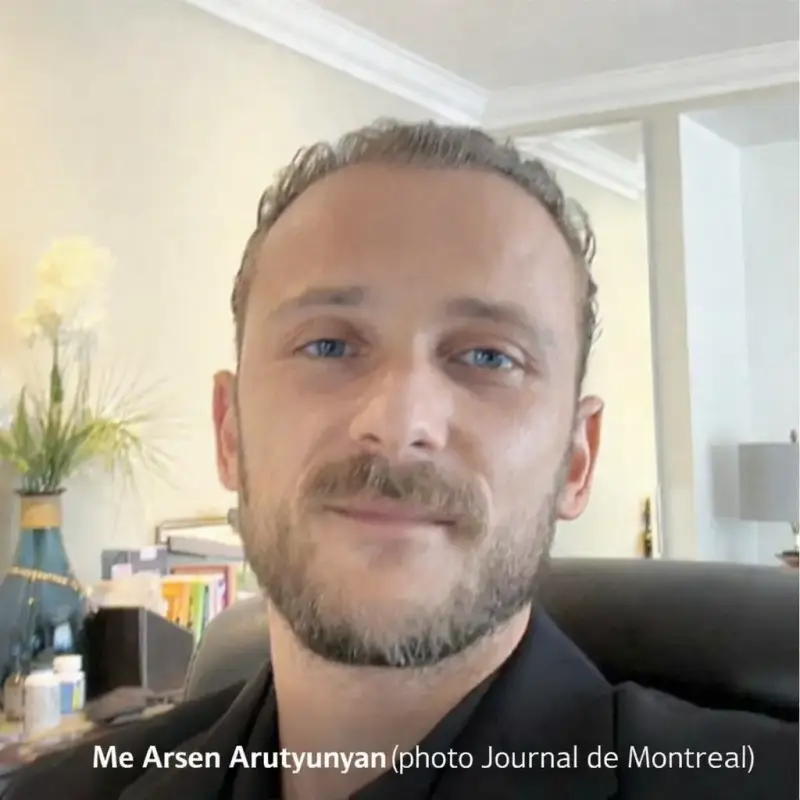
Between December 2024 and January 2025, he drew from his savings to hire Me Arsen Arutyunyan, of the firm Hathaway Avocats Inc., to represent him before the Tribunal administratif du logement and in small claims court. Through successive wire transfers, he paid him $6,312. The payments are documented. The invoices exist.
Then, in March 2025, all communication stopped. The lawyer vanished — no returned calls, no opened emails — leaving his vulnerable client to face court deadlines entirely alone.
What Mr. G. did not yet know: on March 28, 2025, the Barreau du Québec urgently and provisionally disbarred Me Arutyunyan. The official grounds? "Misappropriating funds received from clients" and "obstructing an investigation by the Bureau du syndic."
A Profile the Barreau Should Have Seen Coming
What the disciplinary file reveals — and what Le Journal de Montréal reported in May 2025 — goes far beyond a simple professional failing. Me Arutyunyan was facing a syndic complaint containing 27 infractions. Among them: criminal charges of uttering threats with a firearm and harassment, committed in August 2022 — just one month after his admission to the Bar — which he never disclosed to his professional order.
On top of that came a systematic pattern of deception. On the website hathawaylegal.com, he misrepresented himself as part of a team of experienced lawyers, when in reality he was practicing solo with barely two years of experience, boasting a success rate of over 95%. According to the syndic, this amounted to "a succession of deceptions, schemes and misrepresentations, not only toward the public and his clients, but also toward the courts and the Barreau itself."
All the while, Me Arutyunyan was appearing by videoconference from Playa del Carmen, Mexico, telling the tribunal he was "travelling in Toronto." On at least three occasions, he simply failed to appear at hearings, leaving his clients, in the syndic's own words, "completely helpless and forced to proceed without him." He justified his absences with fabricated car accidents, hospitalizations, and health problems.
In total, at least four clients were defrauded of more than $9,200 — none of which was ever deposited into a trust account, as professional ethics require. The Conseil de discipline was unequivocal: "These failings are numerous, serious, and strike at the very heart of the legal profession." Me Arutyunyan is now believed to be living full-time in Mexico.
The question is not about the lawyer's guilt — it is established, recognized, and sanctioned. The real question is this: how did the Barreau du Québec allow this man to practice for so long? And more importantly: once the disbarment was issued, why were his victims left alone to navigate an institutional labyrinth with no exit?
Three Doors, No Single Window
Rather than being supported, Mr. G. — a severely disabled citizen — was thrust into an institutional obstacle course that has now lasted nearly a year. His case illustrates with devastating clarity the violence of a completely compartmentalized system.
There are three doors — but no single point of entry.
The Bureau du syndic handles discipline. The Fonds d'assurance responsabilité professionnelle handles civil liability. The Fonds d'indemnisation handles misappropriated funds. Legally, this separation may be coherent. Humanly, it fragments the response and exhausts the victims. The internal communications we obtained reveal a bureaucracy spinning in circles, where the left hand has no idea what the right hand is doing.
The absurdity of the syndic. As early as spring 2025, Mr. G. alerted the Bureau du syndic. In December 2025 — eight months after the lawyer was disbarred for theft — an investigator wrote to him requesting his invoices in PDF format to "finalize the evidence." Why is the syndic still slowly investigating a lawyer the order had already found guilty, formally disbarred, and who now lives in Mexico? When Mr. G. emailed his proof, the machine's response was stinging in its administrative coldness: "Received. Please remember to always copy my assistant in future emails."
The paralysis of the Indemnification Fund. On August 4, 2025, following the rules to the letter, Mr. G. filled out and solemnly swore a detailed complaint to the Fonds d'indemnisation. After multiple follow-ups, the Fund finally responded on February 16, 2026: it refused to compensate him for now, because "the Bureau du syndic's investigation is still ongoing." The Indemnification Fund is thus paralyzed by the syndic's interminable investigation — which is itself investigating a lawyer who has already been disbarred and is living in Mexico.
The final blow from the Insurance Fund. On February 25, 2026, the Fonds d'assurance responsabilité professionnelle sent him a terse letter. Their conclusion: they refuse to act. They stated without flinching that they had "no demonstration that a fault was committed" and coldly referred the citizen back to... the syndic.
The Infernal Loop
Let us summarize the absurdity of this trap: a disabled citizen is robbed by a lawyer the Barreau officially disbarred for theft — a lawyer who faced criminal charges from his very first month of practice, who argued cases from a Mexican beach while lying to the tribunal, and who now lives in Mexico beyond reach. A year later, the Insurance Fund tells his victim there is no proven fault and to speak to the syndic. The Indemnification Fund says its hands are tied and to wait for the syndic. And the syndic is still investigating, while asking that its assistant be copied on all emails.
Every institution points to another. None makes a decision. The circle is perfect — and perfectly inaccessible for those trapped inside it.
In mid-February 2026, exhausted, Mr. G. wrote to the Barreau pleading that his file not be closed. He is not arguing a grand legal principle. He is simply asking to be reimbursed for money that was stolen from him.
How Many Silent Victims?
Julien, the autistic father, faced this machine in Superior Court. Mr. G., the disabled man, faces it through forms and unanswered emails. Two different profiles, one same wall. Two distinct stories, one same structure that exhausts those it claims to protect.
A system becomes an instrument of harm when it requires a person living with severe limitations to navigate without error between three unresponsive institutions — with no support, no guaranteed timeline, and no human response.
At what point do we stop calling this an exception? The answer arrives daily: since publishing Julien's story, dozens of similar testimonies have reached Justice-Quebec.ca — ordinary citizens, often vulnerable, who hit the same wall and never received a response. Justice-Quebec.ca will continue documenting these cases, one by one, for as long as it takes.
How many others, without the strength or the means to speak out, have simply given up — abandoned by a system that was supposed to protect them?
The question is no longer whether the system is broken. It is about who it actually protects.
Documents consulted: provisional disbarment decision concerning Me Arsen Arutyunyan, Barreau du Québec, March 28, 2025 — Le Journal de Montréal, Laurent Lavoie, May 23, 2025 — correspondence from the Bureau du syndic, the Fonds d'indemnisation, and the Fonds d'assurance responsabilité professionnelle du Barreau du Québec, 2025-2026 — case documents voluntarily provided by Mr. G.
This website does not provide legal advice. The information published is based on documents obtained directly from the party concerned and on official acts of the Barreau du Québec available to the public. The identity of Mr. G. has been protected at his request.
Ajouter un commentaire
Commentaires